Advance Your Language Strategy through Perfecting RFP Execution
Rebecca Ray
July 19, 2022
0:00
0:00
Listen to This Blog
Organizations often fail to leverage their RFPs as an opportunity to advance their language strategies. Instead, they focus on cost, delivery dates, and punitive measures to be taken if benchmarks aren’t met and thus end up replicating the status quo. But it doesn’t have to be this way year after year. By recognizing underlying goals for launching RFPs and defining specific goals that are tied to corporate-wide initiatives, localization teams can leverage RFPs to advance their strategic objectives.
Recognize Underlying Goals for Your RFPs
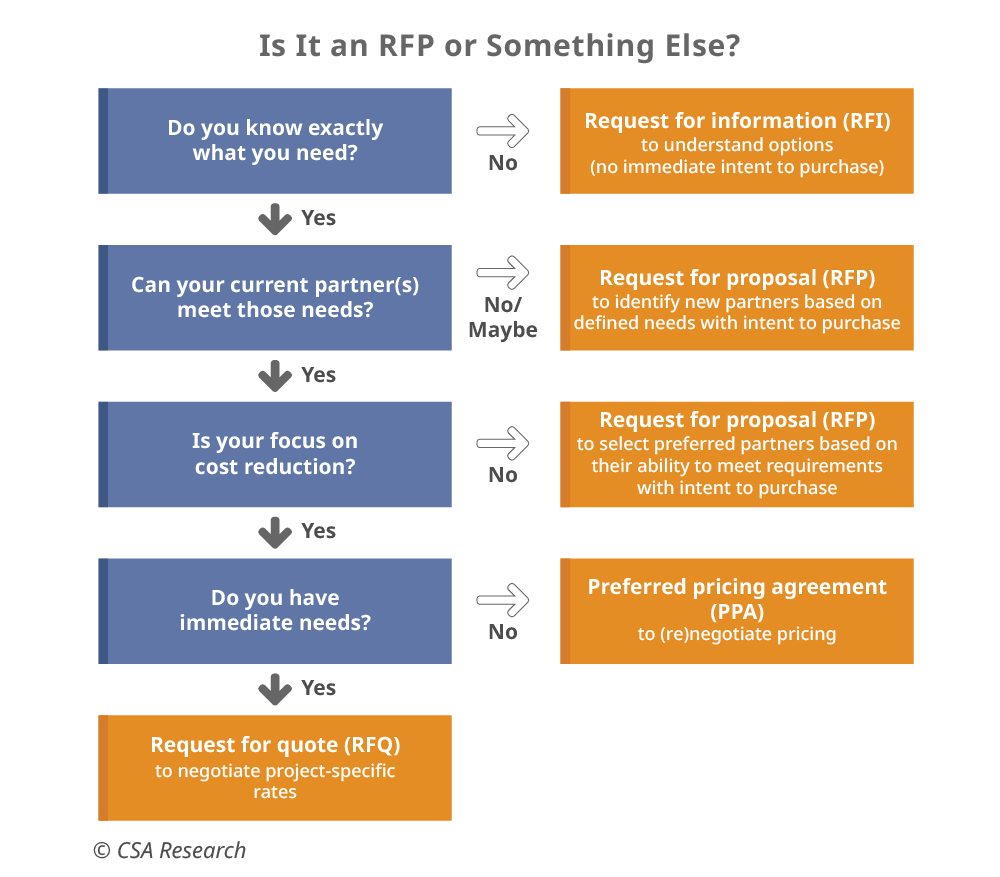
Prior to launching an RFP, the staff responsible need to be clear on their actual intent; otherwise, everyone’s time will be wasted. For example, we often observe organizations labeling a request for information (RFI) as a request for proposal. If you find yourself gathering questions for a request for proposal that is the result of a corporate procurement calendar, because of curiosity about prices, or to pressure current suppliers, think again – and think hard. If you’re distributing a request for information (RFI), with no real intent to purchase, then be honest about it with potential candidates.
Discuss with your stakeholders – including those in sourcing – the possibility to gain in the medium term by investing more in the relationship with your current vendor pool. The same applies even if teammates are disgruntled for quality reasons. It’s not unusual to find that the quality of your source content or weak processes on your part are to blame for most quality dissatisfaction. Switching to another vendor won’t address the root causes.
Is It an RFP or Something Else?
Leverage RFPs as a Strategic Tool to Advance Your Language Strategy
CSA Research often helps firms reconnect tenders and RFPs to their organizations’ overall strategy by reimagining the questions and pushing the request beyond price per word and quality. These tools can address bigger issues such as how to increase revenue, enhance brand awareness, or improve customer satisfaction.
Whether a veteran or new hire, you have a significant choice to make about how to conduct RFPs. You can execute the process as a cumbersome, cost-driven exercise to be dreaded. Or you can recast it as a strategic opportunity to elevate the conversation beyond cost to the essential role that language services play in augmenting global revenue and expanding customer loyalty.
Choose a specific (strategic) objective. Settling on a solid, well-defined, and clearly stated goal for your RFP will make it easier to develop, administer, and evaluate. Start by asking yourself why your organization is issuing this request for proposal. The answer will determine which questions you ask, the colleagues you invite to participate in its creation, and how you conduct the call for proposals.
Use your RFP to meet challenges head-on. Instead of exploiting tenders to play one vendor against another to lower prices in the short term, share your real challenges and make it clear through the RFP where you need help. What business gaps are you trying to fill? Are you encountering big holes in the beginning-to-end customer journey that you offer in local markets? Are you behind in how to integrate artificial intelligence (AI) and natural language processing into your strategic localization plans? The right LSP(s) can help guide you in these areas.
Integrate your RFP with an appropriate enterprise-wide initiative. Is your firm committed to increasing market share in specific regions this year? Are executives feeling pressure to improve customer satisfaction for multicultural audiences in your domestic market? Or maybe you’re moving to offer interpreting services for the first time enterprise-wide. To gain more mileage from your next RFP, tie it to a program that has executive attention. Share the goals with RFP participants and include questions to enable you to identify potential partners with the required expertise. For example, if a corporate goal is to increase global online sales, pose questions about how a participant proposes handling SEO and other metadata.
Enable stakeholders to gain more visibility through the purchasing process. As you shift the perspective on tenders from saving money to enabling revenue, consider how internal stakeholders can serve as globalization ambassadors in the farthest corners of your organization. At the same time, they can benefit by raising their own visibility. Create an elevator pitch that the whole RFP team can use. Ensure that all stakeholders – including procurement – are ready with a succinct statement to position language services as a critical component for international revenue, rather than as a cost center.
Train procurement as a strategic partner to support you in your mission. Without proper training, procurement staff tend to treat translation as a commodity because they lack the knowledge for how to lead deeper conversations around quality management, advances in machine translation, AI and machine learning, and language technology requirements. They need your help to understand the value and return on investment for the language process. Strive to understand how they engage with purchasers and how they’re measured.
In summary, validate that an RFP is what you need. If the mandate is based on an arbitrary request from procurement or the desire to pressure current partners in certain areas, then an RFP is not your answer. Investigate the possibility of gaining more by investing in your relationship with current vendors. If you do require an RFP, elevate the process to advance your language strategy. Expand the conversation beyond cost and quality to the essential role that language services can play in augmenting global revenue, enhancing brand awareness, improving customer satisfaction, and optimizing processes.
A former Rotary International scholar and Silicon Valley veteran, Rebecca co-authored Doing Business in the USA, a book for global high-tech companies.
CSA Research materials are copyrighted and provided solely to authorized users.
You are prohibited from submitting any CSA Research content to
generative AI tools, machine-learning systems, public or shared platforms, or any service
capable of storing, training on, or redistributing the material. You may not copy, record,
share, translate, or upload any portion of this content beyond your licensed rights
Unauthorized use, disclosure, or distribution may violate applicable laws. For
permissions or to report misuse, contact legal@csa-research.com.
We use cookies and similar tracking technologies to analyze site traffic and understand how you interact
with our website. This includes using tools to capture behavioral metrics and heatmaps so we can improve our
site design. By clicking 'Accept', you consent to this tracking. You can learn more in our Privacy Policy.