

Home > Blogs & Events > Blogs
January 20, 2026
Artificial intelligence (AI) is no longer an emerging topic in localization or global content operations. In 2026, AI maturity will become a decisive factor separating organizations that scale global content responsibly from those that struggle to remain relevant.
CSA Research’s 10 Predictions for 2026 identify trends that indicate that the next phase of AI adoption will not be defined by automation alone. As global content volumes expand and traditional translation revenue models face pressure, then differentiation, governance, and measurable return on investment will increasingly determine competitive advantage.
The predictions highlight trends and structural shifts affecting enterprises, language service providers, and global content strategists. Three of these stand out as particularly important for understanding where the industry is heading in the coming year.
AI maturity will become a key dividing line between organizations that scale and govern effectively and those that fall behind.
Generalist language service providers will continue to lose market relevance as buyers demand specialization and solutions.
Translation revenue is expected to decline even as global content volumes grow.
AI-driven price compression will reshape traditional market assumptions.
Enterprises will prioritize governance, complexity management, and workflow orchestration.
Scenario-based planning will become more important than static market forecasts.
Global content production is expanding across platforms, formats, and markets. At the same time, AI is changing how organizations produce and manage multilingual content.
The key challenge is no longer translation speed. It is managing the complexity of global content operations across teams, technologies, and governance structures. This shift affects both enterprises managing global communication and the language service providers supporting them.
CSA Research’s 2026 predictions highlight several structural pressures shaping the next phase of the industry.
Key challenges include:
AI-driven price compression reducing the economic value of traditional translation services
Buyers demanding specialized expertise and targeted solutions rather than general translation capabilities
Rapid growth in multilingual content volumes across platforms and formats
Increasing governance requirements around compliance, risk, and accountability
Difficulty forecasting market growth using traditional translation revenue models
These forces are pushing organizations to rethink both operational models and strategic positioning.
One of the clearest predictions for 2026 is the continued erosion of the generalist language service provider model.
For many years, providers positioned themselves as vendors capable of translating any content into any language – they sold words. This approach is becoming less viable as buyers increasingly seek partners who understand specific industries, workflows, and regulatory environments.
Enterprises are no longer evaluating providers purely on translation output. Instead, they are assessing partners based on their ability to support broader business objectives such as:
Global customer experience
Regulatory compliance
Content governance
Risk management across markets
In this environment, specialization becomes essential. Providers that cannot demonstrate clear authority within specific industries, content types, or business functions may struggle to differentiate themselves.
Another prediction challenges a long-standing assumption in the language services industry.
Global content production is growing quickly, but this growth will not translate directly into higher translation revenue for LSPs. AI-driven workflows are introducing strong price compression across many language services. As a result, LSPs relying on traditional translation pricing models may see revenue stagnate or decline even as the amount of content they deliver increases.
This shift creates several strategic implications:
Market size estimates based on static translation revenue models become less reliable
Investors and executives may misinterpret industry growth trends
LSPs must develop new value propositions beyond translation throughput
Forward-looking LSPs, GCSPs, and enterprise localization leaders are beginning to adopt scenario-based planning models that account for:
Regional variation
Regulatory changes
Evolving buyer expectations
AI adoption
After several years of experimentation aimed at replacing human translation with AI, many enterprises are reassessing where the technology provides the greatest value. In practice, the largest operational challenge in global content is not translation itself. It is managing complexity.
AI is increasingly being deployed to address issues such as:
Coordinating multilingual workflows across teams
Managing governance and compliance requirements
Improving decision-making across distributed content operations
Integrating content systems and automation tools
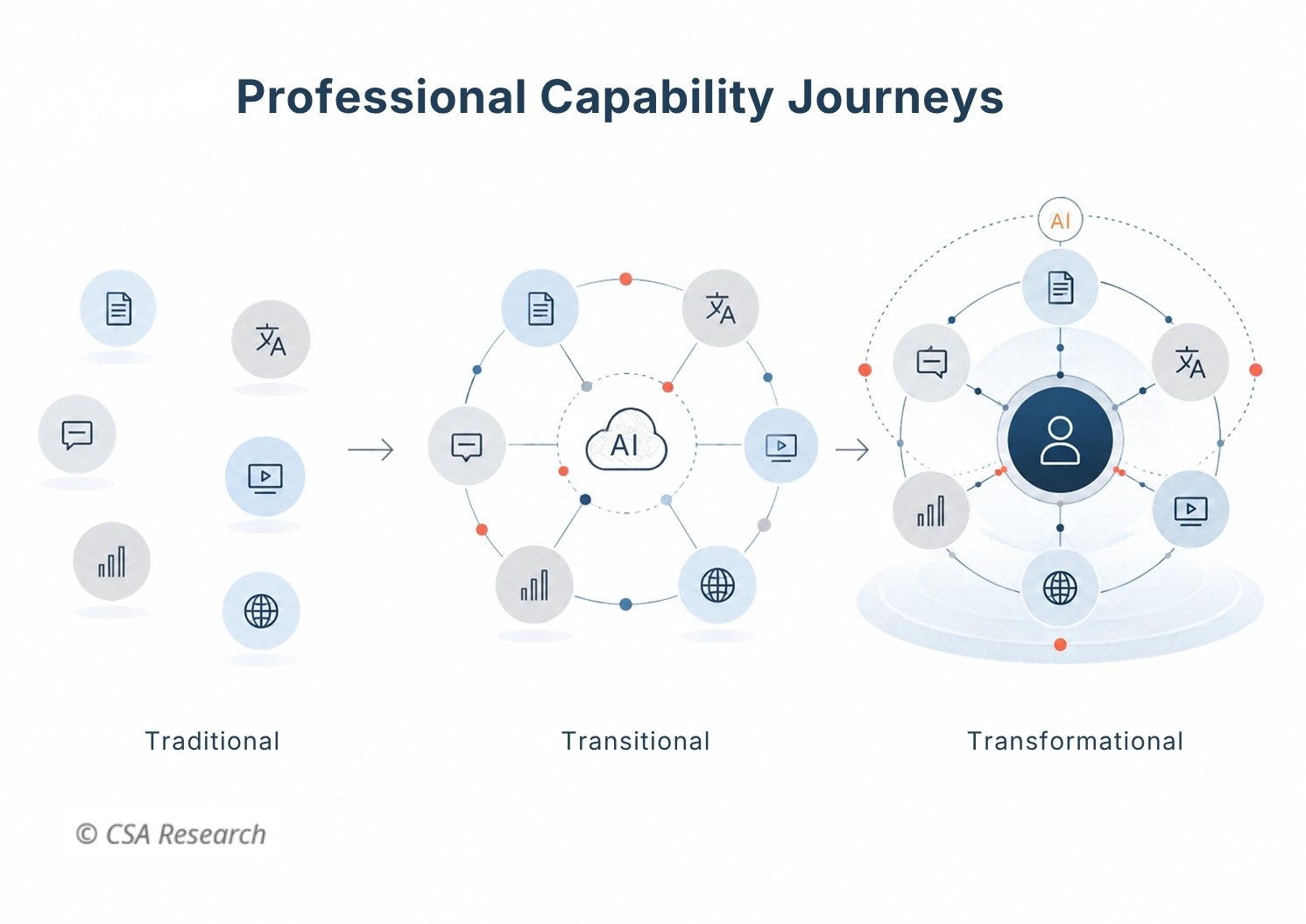
This shift represents an important strategic correction. While AI is frequently framed as a standalone replacement for human translation, in practice it does not function autonomously. Fully automated global content management remains unrealistic without human oversight. Organizations are therefore repositioning AI as an orchestration layer for complex global content environments.
These trends point to a broader transformation in how organizations approach multilingual communication.
For enterprises, global content operations are expanding beyond localization teams and becoming embedded across marketing, product development, customer support, and compliance functions.
For language service providers, the competitive landscape is changing. Providers must demonstrate expertise in areas that extend beyond translation output, including content strategy, technology integration, regulations and accessibility, and workflow management.
Across the localization industry, the ability to manage complexity, maintain governance, and deliver measurable business value will increasingly shape competitive advantage.
Language service providers (LSPs) and enterprise buyers preparing for the next phase of AI adoption must focus on strategic positioning rather than short-term automation gains.
To respond effectively, priorities should be differentiated by stakeholder group:
For Language Service Providers (LSPs)
LSPs must adapt their business models to remain competitive in an AI-driven environment:
Develop specialization strategies rather than competing as generalist providers
Reevaluate revenue models to account for AI-driven price compression
For Enterprises (Buyers of Language Services)
Enterprises must strengthen how they manage and scale global content operations:
Invest in governance frameworks for managing global content operations
Adopt scenario-based planning models instead of relying on static market forecasts
Shared Priorities (LSPs & Enterprises)
Both sides of the market must evolve how they deploy and operationalize AI:
Focus on workflow orchestration and complexity management when deploying AI
Align global content strategy with broader enterprise objectives
These actions can help organizations adapt to structural shifts already underway in the industry.
After several years of experimentation by enterprises and their language supply chain aimed at replacing localization with AI, 2026 marks a strategic correction.
CSA Research’s 10 Predictions for 2026 highlight a critical transition: The future of the industry will not be defined by who can produce translation the fastest, but by who can manage global content complexity, demonstrate specialization, and deliver measurable business value.
Enterprises will recognize AI’s true value not in eliminating humans, but in managing complexity. Buyers will increasingly pay for solutions that simplify governance, decision-making, accountability, and global workflows rather than for raw throughput gains.
Discover all 10 predictions shaping AI, localization, and global content in 2026 here.
Contact us for support navigating this transformation journey.
Subscribe to our newsletter for updates on the latest research, industry trends, and upcoming events.
SubscribeOur consulting team helps you apply CSA Research insights to your organization’s
specific challenges, from growth strategy to operational excellence.