What Is Happening to US Language Capacity and Why It Matters
Two well-known US institutions of higher education recently announced the closure of their foreign language programs. Their shuttering barely registered as news, but it should have.
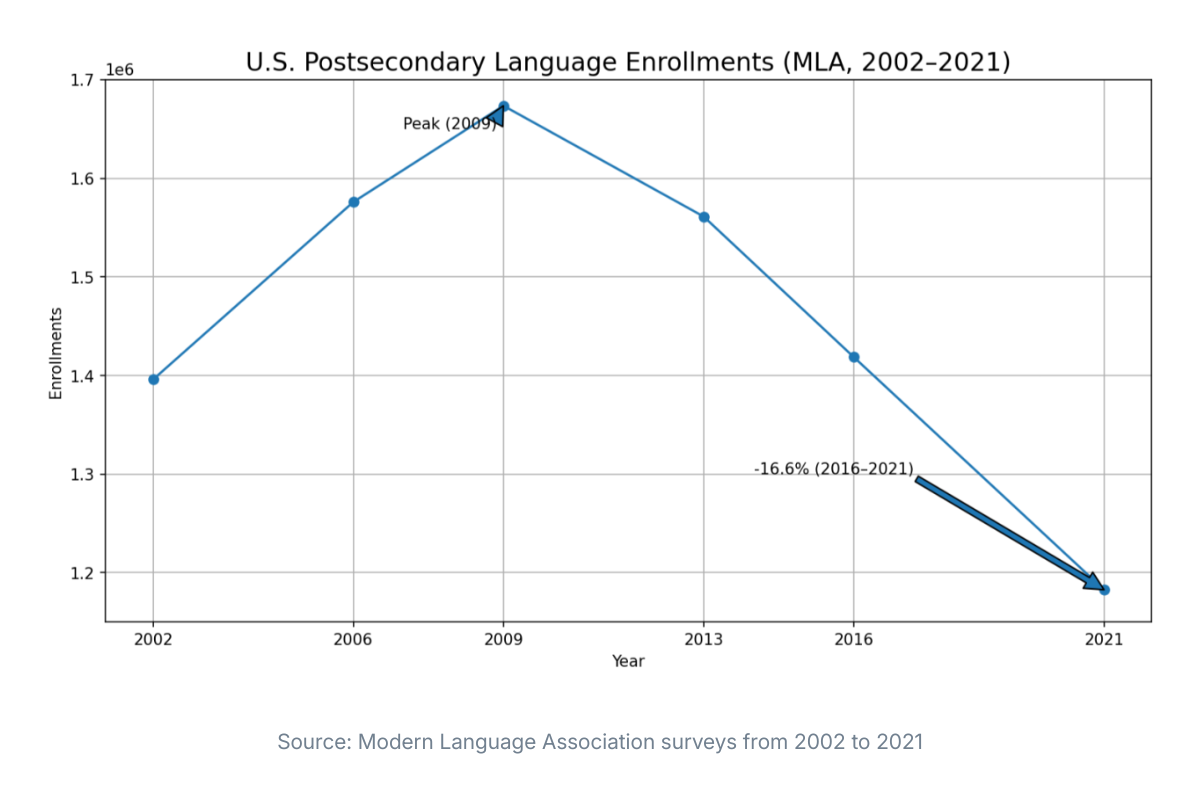
According to the Modern Language Association (MLA), which has tracked US language enrollment since 1959, total enrollment in higher education reached nearly 1.4 million by 2002, continuing a decades-long expansion before peaking in 2009. But for the following two decades, US higher education has been quietly reducing its capacity to produce advanced linguistic and cultural expertise. The latest datapoint from the MLA, a 16.6% enrollment decline between 2016 and 2021, is not an isolated downturn but part of a longer structural shift.
This decline is often framed as an educational trend or a workforce issue, but it reflects a deeper problem: diminishing capacity. Language capability underpins how a country conducts diplomacy, interprets intelligence, negotiates markets, and builds globally relevant technology.
How Language Capacity Erodes Over Time
When advanced language programs thin out, that capacity does not disappear evenly, it fragments, concentrates, and in some places, vanishes entirely. Once capacity erodes, the capability to teach, apply, and research follows. The consequence: the ability to produce linguistic and cultural expertise is inseparable from the expertise itself.
From Decline to Structural Fragility
MLA survey data from 2006 to 2021 describes a system under sustained stress. The decline was gradual, then accelerated, and is now visible in both enrollment and program loss. The more revealing signal lies beneath the surface.
While the MLA’s surveys do not explicitly frame the system in these terms nor do they draw causal conclusions across levels, their data suggests a consistent pattern, graduate enrollments weaken earlier and more sharply than undergraduate totals. Graduate enrollments appear to have peaked earlier than overall enrollments (2006 vs. 2009), reinforcing the pattern of earlier weakening at advanced levels.
That diminished graduate-level capacity matters. When graduate pipelines shrink, faculty positions contract, and research output declines. Departments that once functioned as intellectual centers shift toward service roles that primarily support general education requirements. At the undergraduate level, introductory enrollments may persist because of degree requirements, but advanced study thins. The system becomes broader but shallower.
Undergraduate and graduate students are not oblivious to these signals. As tenure-track opportunities contract, fewer students enter the pipeline for master and doctoral degrees. The result is a self-reinforcing cycle of decline.
Where Language Capacity Breaks First
The state of less commonly taught languages (LCTLs) makes this fragility visible. Many are offered at only one or a handful of institutions and depend disproportionately on federal support and individual faculty.
At the same time, the United States is more linguistically diverse than ever. Demand for multilingual capability persists across healthcare, courts, intelligence, trade, and beyond. But demographic presence is not institutional capacity. While the US may have speakers of these LCTLs, it doesn’t have specialists. As smaller programs disappear, capacity thins precisely where it is hardest to rebuild.
The Structural Outcomes of Declining Language Capacity
The erosion of language programs leads to several
Capacity does not shrink uniformly, but concentrates. As programs consolidate into fewer institutions, what might be called “knowledge deserts“ emerge. Entire geographic regions lose advanced instruction forcing students to relocate or abandon their studies. Graduate pipelines narrow even further.
These gaps in language instruction become gaps in accumulated intellectual, cultural, and geopolitical expertise that tend to become visible only under stress. The thinning out or ultimate absence of expertise is rarely obvious in advance, but it becomes visible in moments that require interpretation under pressure.
Overall, the efficiency of the academic system improves but its resilience declines. Once expertise clusters in a small number of institutions, national capability becomes increasingly sensitive to individual institutional decisions. That is a structural vulnerability that will become more apparent as institutions such as the Middlebury Institute and UW-Madison announce plans to shut down language programs and resource centers.
AI as an Accelerant, Not a Cause
This trajectory predates COVID and AI. The pandemic accelerated it. AI arrived on top of it.
While artificial intelligence did not cause the decline in language education, it may accelerate consolidation while fostering the perception that human linguistic capacity is no longer strategic given the ubiquity of machine translation and multilingual chatbots.
AI tools are effective for routine interactions but they are less reliable in intelligence analysis, negotiation, and cultural interpretation. They are certainly useful but not equivalent to humans in many use cases.
They also pose a paradox, AI models depend on linguists, annotated data, and cultural expertise. As graduate pipelines contract and LCTL programs thin, the human substrate supporting multilingual AI weakens.
Why This Is an Infrastructure Problem, Not a Cultural One
It is tempting to view this as a cultural issue but it’s really an infrastructure problem. Advanced linguistic and cultural expertise underpins diplomacy, intelligence, trade, and technological development.
As that capacity contracts while technological mediation expands, reliance shifts from expertise to tools.
There is also an asymmetry problem. If US programs shrink while other countries continue developing multilingual capabilities across a wide range of language pairs, interaction becomes one-sided. Such asymmetry rarely leads to a position of advantage in international relations with strategic implications that may not be immediately visible to government efficiency experts.
Language capacity is strategic infrastructure. Programs that take decades to build can be dismantled quickly through a series of institutional decisions.
Similar patterns are emerging in other English-dominant systems, including the United Kingdom. This may not be purely a national phenomenon, and it’s worth a closer look.
What Comes Next
The trend from 2006 to 2021 identified in MLA surveys already suggests a system moving from gradual decline to structural contraction. The forthcoming 2022–2027 MLA report will provide a critical indicator: stabilization, consolidation, or continued erosion.
If the current trajectory continues, the issue will no longer be one of academic preference but of national capacity to sustain and rebuild linguistic, geographic, and cultural knowledge.
This is not a uniquely US pattern. provides more information on this topic.