There is a longstanding assumption in global business that enough people are comfortable using English online that a company can sell to them without localizing the buying experience, particularly when the product is high-tech or expensive. I would argue that this assumption confuses what customers can do with what they prefer to do, and CSA Research’s 2020 “Can’t Read, Won’t Buy™ – B2C” survey shows how wide that gap is. Based on 8,709 verified responses from consumers in 29 countries, we found that 76% of online shoppers prefer to buy products with information in their native language and that 40% will not buy from websites in other languages at all.
These two numbers have been widely cited since we published them. However, they are only the top line. The underlying data – which also covers English-language proficiency, nationality, price, global brand recognition, and customer care – tell a more nuanced (and, for anyone building a business case for localization, considerably more useful) story about where language changes the outcome of a purchase and where it competes with other factors.
Key Findings
All figures below come from CSA Research’s “Can’t Read, Won’t Buy™ – B2C” (2020), a survey of 8,709 consumers in 29 countries in Europe, Asia, North America, and South America, conducted with Kantar.
Note: When citing these findings, please attribute them to CSA Research, “Can’t Read, Won’t Buy™ – B2C” (2020), and link to
How We Gathered the Data
We worked with survey specialist Kantar on the 2020 edition, as we had on earlier studies in the long-running “Can’t Read, Won’t Buy™” series. Kantar vetted 31,933 consumers around the world and eliminated thousands of them through its patented Honesty Detector software, filters, and trap questions, which left 8,709 verified responses. The survey was conducted in the official language of each of the 29 countries (plus Spanish in the United States) and covered markets that included Brazil, China, Egypt, Germany, Japan, and Turkey.
The design matters for how the results can be used. Because we asked about nationality, English-language proficiency, global brand recognition, and the ability to transact in local currencies alongside language, the data let us separate the effect of language from the other factors that generally shape a purchase. In other words, the study does not simply ask people whether they like their own language (most people, unsurprisingly, do). It asks what they do when language is traded off against something else they value.
Note: This data was collected in 2020, before generative AI tools became widely available to consumers, so some behaviors – particularly the use of machine translation – have likely shifted since then.
The data shows the gradient clearly. Overall, 76% of respondents preferred products with information in their own language, but that figure rose to 89% among those with no English-language competence. Even at the other end of the scale, the preference did not disappear: 60% of the respondents who were most confident in reading English still favored customer care in their own language. A customer’s ability to use English, in other words, does not by itself tell you which language that customer will choose when their own money is on the line.
Language Competes with Price and Brand
None of this means that language determines every purchase. While it is true that most consumers prefer their own language, the survey also shows that this preference can be outweighed. Given the choice between two similar products, 66% of respondents would choose the less expensive one, even if it did not have information in their language. A full 69% would choose a major global brand over one that offered information in their own language.
These trade-offs are not evenly distributed. The willingness to trade understanding for price drops as English-language competence declines: Just 48% of respondents with no English-language competence would make that trade. Brand pull varies by nationality as well. Vietnamese respondents were the most attracted to global brands (85% agreed or strongly agreed), while Japanese respondents were the least (50%).
The rub is that both of these factors favor companies that already have an advantage. A price leader or a household-name brand may be able to get away with less localization, at least in some markets and for some customers. However, most companies are neither, for them language is one of the few purchase factors they fully control. Language is also not the only cross-border factor: Privacy, payment methods, delivery, and customs all affect the online customer experience and generally need to be planned alongside it.
Language Matters Across the Customer Journey
Many organizations still treat localization as a website project. The research examines language across the customer journey, and the findings suggest that the website is only one of several points where language potentially affects the outcome.
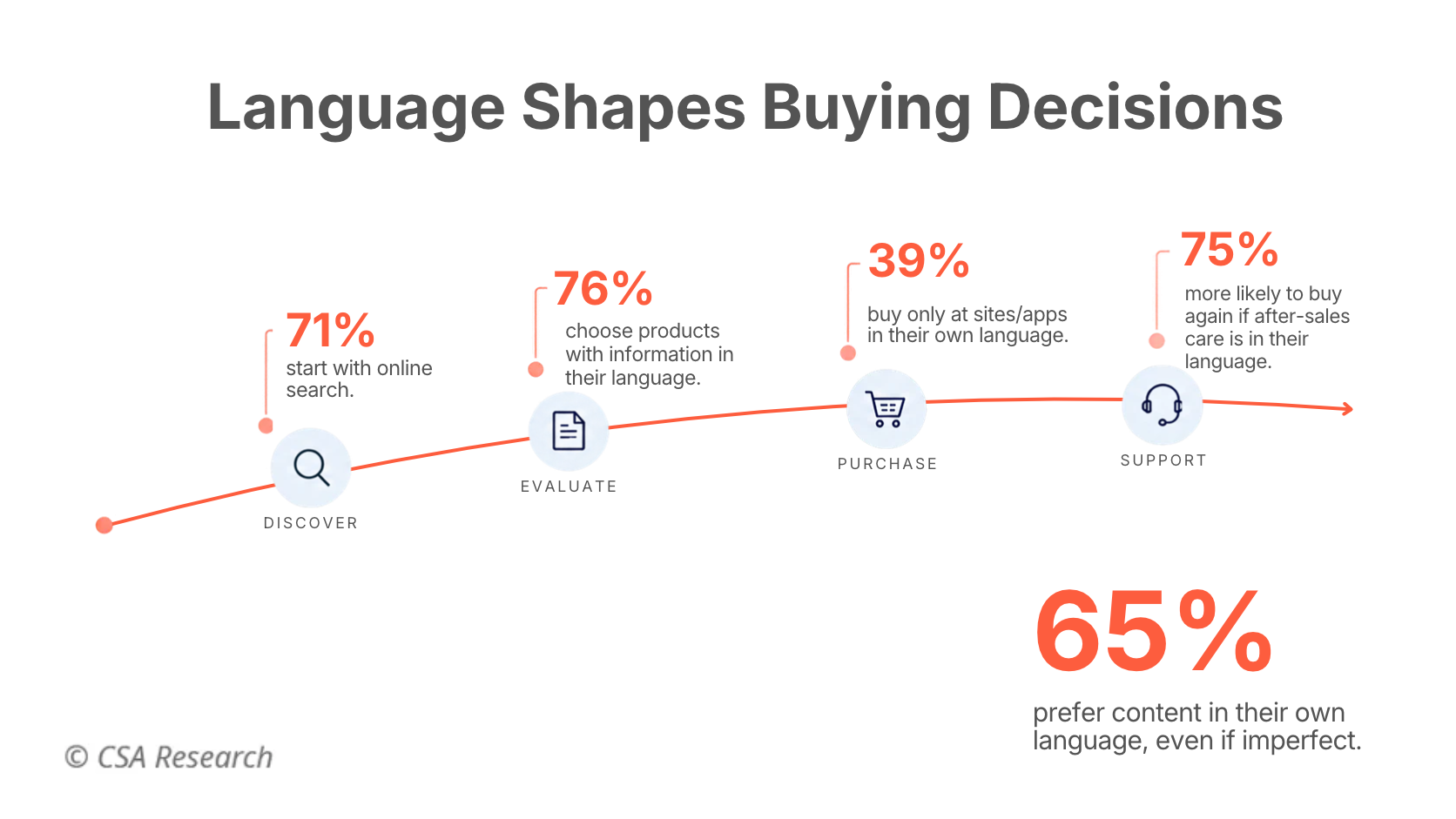
Before a purchase, customers rely on product descriptions, specifications, and reviews to compare options, and 73% of respondents want product reviews in their language. At the point of purchase, they deal with pricing, transaction details, and terms. After the sale, documentation and customer care take over, and this is where the data is particularly striking: 75% of respondents said they are more likely to buy from the same brand again if customer care is in their language. In other words, local-language support likely does more than win the first sale, because it makes the customer relationship “stickier” over time.
The data also says something about how much consumers expect from that content. Almost two-thirds of respondents (65%) prefer content in their language even if its quality is poor, 67% tolerate mixed languages on a website, and 66% use online machine translation (MT). These figures do not mean that quality is irrelevant. Rather, they suggest that consumers are pragmatic and that many would rather have “good enough” content in their language than polished content in a language they have to work at. For organizations deciding how far to extend language coverage, this potentially opens room for tiered approaches, for example, using MT for long-tail content such as reviews while reserving more intensive processes for high-impact content.
Connecting Language Preference to Localization Investment
When we released the 2020 data, my colleague Don DePalma made the point that a company that chooses not to localize the buying experience risks losing 40% or more of its total addressable market (TAM), namely the consumers who prefer to select and buy products at local-language sites. That is a useful way to frame the stakes. However, a survey percentage is not a revenue forecast, and preference data does not by itself establish a guaranteed return on investment (ROI) from translation. Organizations need to combine this evidence with their own market, customer, and financial data, and it generally makes sense to start with three questions:
-
Do the languages you support match the markets you want to serve? Compare your current language coverage with the markets and customer groups in your growth plans. A gap between the two is where the findings on consumers who buy only in their own language (40% overall and 57% in Germany) are most likely to apply to you.
-
Where in the customer journey could language stop a customer from proceeding? Look beyond the website to product information, reviews, purchasing interactions, documentation, and customer care. The 75% figure on repeat purchases suggests that post-sales support may deserve more attention than it receives in many localization budgets.
-
Are your commercial assumptions grounded in your own data? Evaluate language preferences alongside your own revenue, cost, and customer data rather than applying a survey average to every market. The country-level differences in the research – from 94% preference for local-language product information in Taiwan to Romania, where 48% were satisfied with English – are a reminder that averages can mislead.
What It Means
The good news is that the evidence for local-language content is consistent: Most consumers prefer it, many will not buy without it, and the preference persists even among confident English readers. The bad news (at least for anyone hoping for a simple rule) is that language competes with price, brand, and other cross-border factors, and how that competition plays out varies considerably by market and by customer.
The larger point is that English proficiency is not a localization strategy. I would argue that the organizations that get the most out of these findings will be the ones that treat them not as a mandate to translate everything, but as evidence for deciding which markets, content, and customer interactions deserve investment first.
Related
Frequently Asked Questions
What Is “Can’t Read, Won’t Buy™”?
“Can’t Read, Won’t Buy™” is a long-running CSA Research series that examines how language preferences affect purchasing decisions and customer experience across international markets. The 2020 B2C edition surveyed 8,709 consumers in 29 countries, and a companion B2B study examines business buyers.
What Percentage of Consumers Prefer to Buy in Their Own Language?
According to CSA Research’s 2020 survey of 8,709 consumers in 29 countries, 76% of online shoppers prefer to buy products with information in their native language. That figure measures preference, so it does not mean that 76% will always refuse to buy in another language. However, 40% said they will not buy from websites in other languages.
Do Customers Who Speak English Still Prefer Their Own Language?
Generally, yes. Preference for local-language content increases as English-language proficiency declines, reaching 89% among consumers with no English-language competence. However, it persists even among confident English readers, 60% of whom still favor customer care in their own language.
Is Website Translation Enough for International Customers?
In a word, no. The website is only one part of the customer journey. Consumers also rely on product information, reviews (73% want them in their language), documentation, and customer care, which makes 75% of consumers more likely to buy from the same brand again when it is offered in their language.
Can Price or Brand Outweigh Language Preference?
Partially. Of the consumers surveyed, 66% would choose a cheaper similar product without information in their language, and 69% would choose a major global brand over one with local-language information. However, the price trade-off drops to 48% among consumers with no English-language competence.
How Can Companies Estimate the Value of Localization?
Companies need to start with their own data. That means comparing language coverage to target markets, identifying where in the customer journey language gaps exist, and testing survey-based assumptions against their own revenue and customer data. CSA Research’s Global CX Calculators and Global Revenue Forecaster™ can support that analysis.