AI and automation are changing the work language professionals do, the skills employers and clients expect, and where specialist expertise can make a difference. The question is not simply how to keep up with new tools. It is how to build on what you already know as enterprises connect language work more closely with technology, knowledge, governance, and business operations.
For language professionals, this shift creates different opportunities depending on one’s experience and goals. Some may deepen their specialization; others may apply the same expertise in adjacent functions.
TL;DR
-
Translators, interpreters, terminologists, localization engineers, localization managers, and project managers can extend different specialist capabilities into wider enterprise work.
-
The Traditional, Transitional, and Transformational (3T) stages describe changing work and opportunities, not one mandatory career sequence.
What Is Changing for Language Professionals?
Language professionals are moving from work defined mainly by specialist delivery toward work that applies the same expertise inside integrated, automated, and AI-assisted operations.
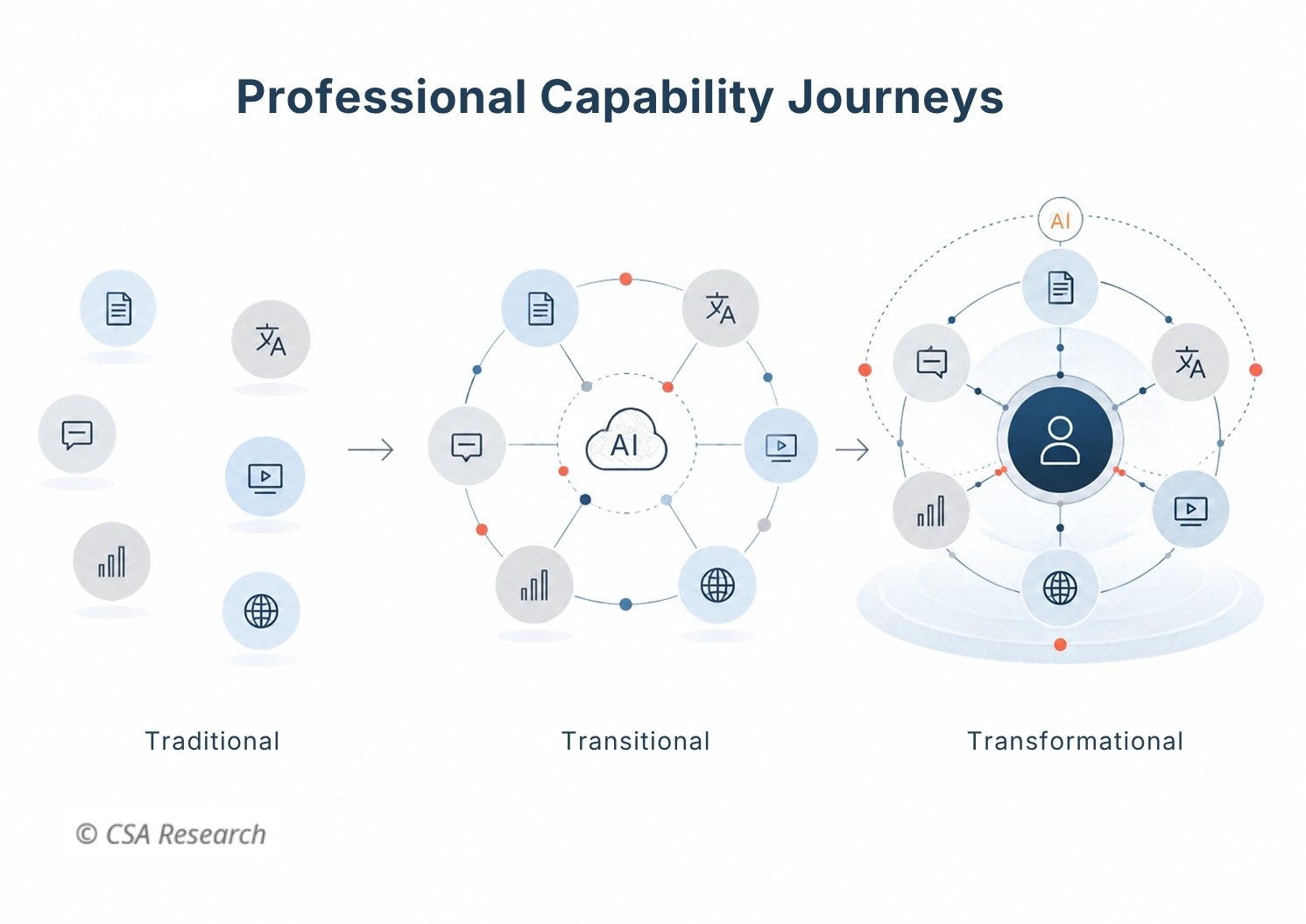
CSA Research describes that evolution as Traditional, Transitional, and Transformational work. Traditional work centers on specialist linguistic, technical, operational, or management expertise; Transitional work applies that expertise in increasingly integrated and automated workflows; Transformational work extends it into capabilities that enterprises can apply across functions, systems, and markets. Those stages describe changing work and opportunities, not a mandatory sequence that every individual must follow.
The stages are not job titles, and they do not imply that Traditional work stops mattering once more automated or cross-functional work appears. A translator still has to preserve meaning; a localization engineer still has to make systems work; a project manager still has to coordinate delivery. What changes is the context in which that expertise is applied and the range of enterprise outcomes it can support.
How Do Six Professional Roles Extend into Enterprise Capability?
The common structural change across the six professions is that specialist expertise becomes useful beyond the boundaries of the original job, while the distinctive professional capability itself remains necessary.
CSA Research identifies six distinct ways that specialist expertise can extend into enterprise capability:
Translator
Translators protect meaning, intent, tone, terminology, and cultural appropriateness. In AI-assisted workflows, this expertise can extend to evaluating generated content, improving multilingual AI output, and helping maintain consistent language across an organization. A translator with deep domain knowledge, for example, may help ensure that AI-generated product or policy content uses the right terminology and preserves the intended meaning across markets.
Interpreter
Interpreters make spoken or signed communication possible when understanding cannot wait. Their expertise can inform language-access and accessibility practices, remote and hybrid communication, and the evaluation of speech and signed-language technologies. They can help organizations assess whether real-time communication tools support understanding in the situations where it matters.
Terminologist
Terminologists establish conceptual and terminological consistency. This knowledge can help an enterprise reconcile conflicting definitions across departments, build consistent taxonomies, or govern terminology used by AI systems. Their contribution extends beyond maintaining termbases: it can help organizations make information clearer and more consistent across content, systems, analytics, and decisions.
Localization engineer
Localization engineers internationalize products, integrate systems, automate workflows, and troubleshoot technical problems. These skills can support broader global content infrastructure, including connected content systems, automated pipelines, and AI-enabled workflows. An engineer who understands how content moves between platforms can help build integrations that make global content operations more reliable and scalable.
Localization manager
Localization managers coordinate demand, budgets, suppliers, technology, quality, linguistic assets, and internal stakeholders. Their view across people, processes, and systems can support broader global content operations, stronger governance, and business-oriented measurement. They may help connect localization planning with product launches, customer experience, accessibility, AI use, and organizational priorities.
Project manager
Project managers coordinate planning, resources, risks, communication, and delivery. As automation handles more routine scheduling, reporting, and routing, their value increasingly lies in managing exceptions, competing priorities, stakeholder expectations, and uncertainty. These skills can transfer into cross-functional programs and transformation initiatives where people, systems, and business objectives must stay aligned.
The six roles therefore offer different directions for growth. A terminologist’s expertise in conceptual consistency is not interchangeable with a localization engineer’s integration skills, just as an interpreter’s focus on real-time understanding differs from a project manager’s coordination of execution.
How Should Language Professionals Decide Where to Expand Next?
The practical test is whether a new capability builds on professional expertise and connects it to an enterprise outcome, rather than simply adding technology skills for their own sake.
The report findings suggest four questions that help keep that expansion grounded:
-
What specialist judgment must remain trustworthy? Identify what your profession protects, such as meaning, understanding, conceptual consistency, operational resilience, enterprise processes, language risk, or coordinated execution.
-
Which enterprise outcome could benefit from this judgment? Consider outcomes such as customer experience, compliance, risk reduction, knowledge management, accessibility, product delivery, resilience, or growth.
-
Where can AI and automation scale the work without taking over consequential decisions? Look beyond familiarity with a tool. Consider where automation adds value, where it introduces risk, and where human review remains necessary.
-
What cross-functional fluency would help you contribute? Depending on your goals, that may mean working more effectively with product, engineering, content, accessibility, customer experience, knowledge management, legal, compliance, or AI teams.
AI can help scale capability, but it is not magic. The value sits in knowing when automation is fit for purpose, where professional judgment still carries risk, and how existing expertise can connect to a wider enterprise need.
The question is not whether everyone should move in the same direction. It is where your existing expertise can solve a broader enterprise problem while keeping meaning, understanding, resilience, or execution trustworthy.
Professional capability refers here to the specialist expertise, judgment, and applied skills a professional utilizes to deliver trustworthy outcomes. In the 3T model, that capability can extend into broader enterprise contexts while retaining its specialist foundation.
Enterprise capability refers to specialist expertise extended so that it can be applied across functions, systems, workflows, and markets. It connects professional knowledge with broader organizational needs such as communication, knowledge, governance, accessibility, resilience, and execution.