ALC Annual Summit 2026: What the Survey Says About the Market
Arle Lommel
November 11, 2026
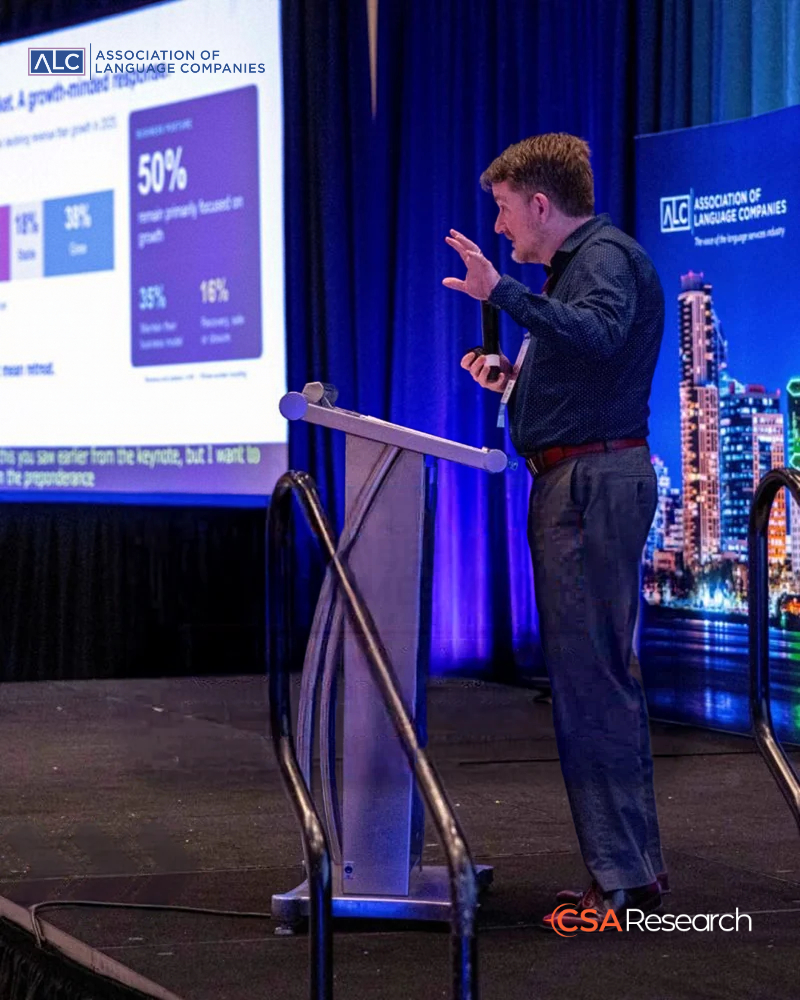
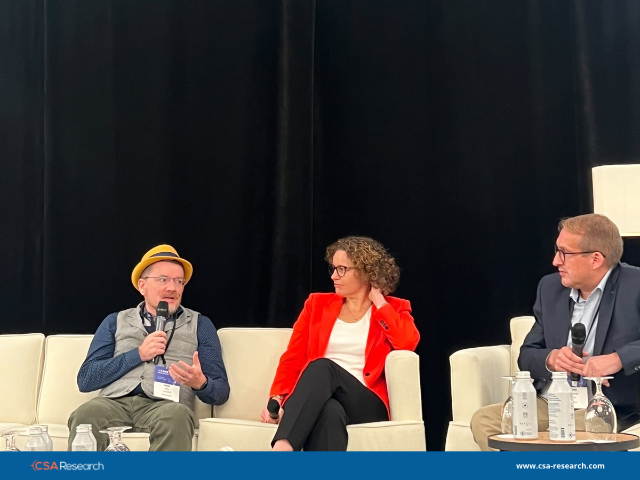
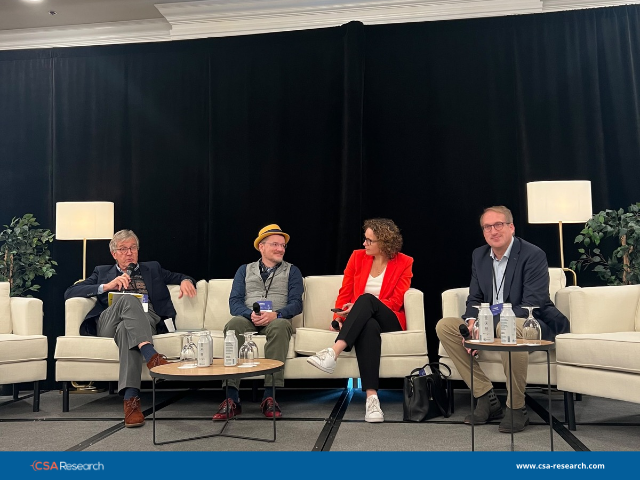
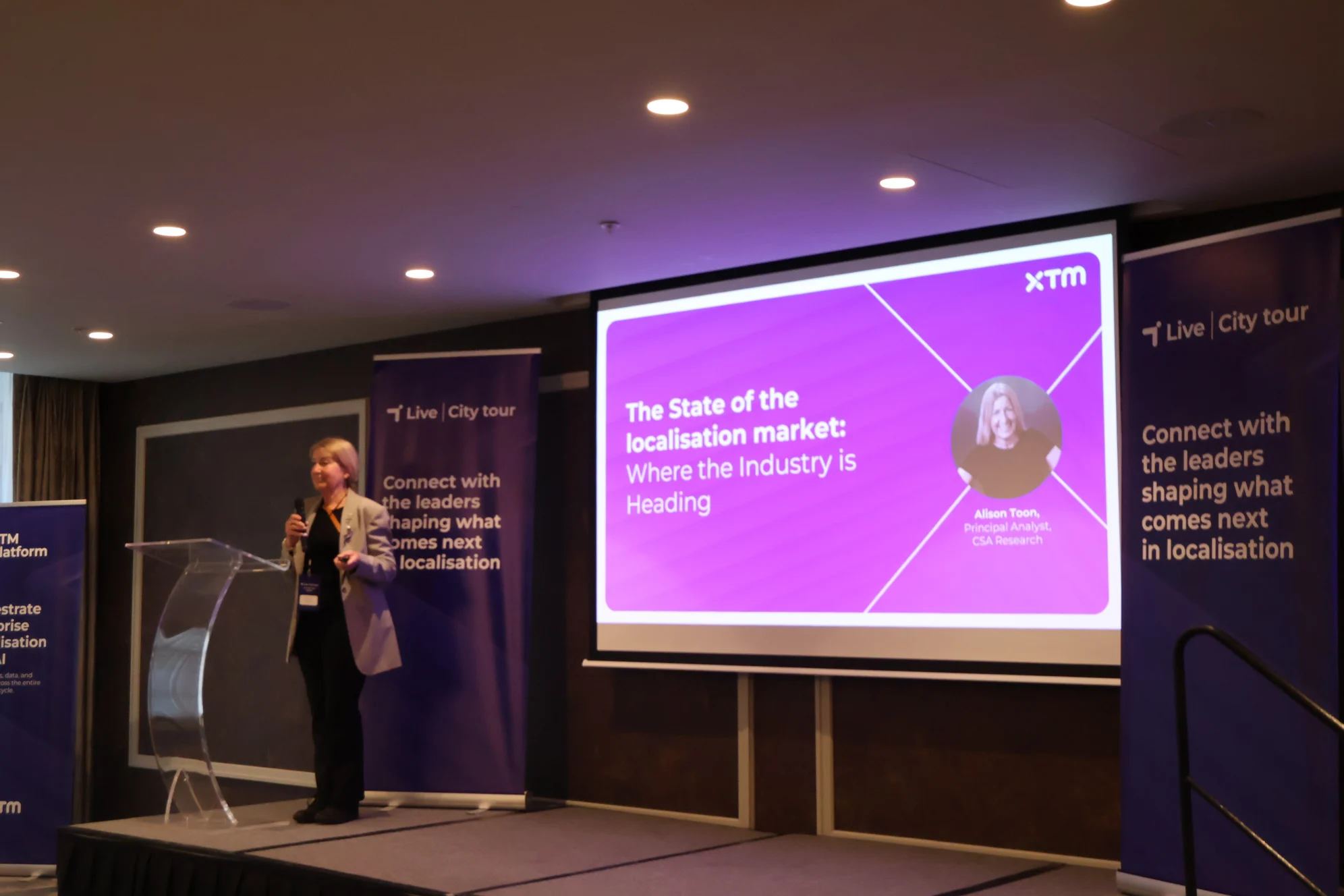
At the ALC Annual Summit 2026, the Association of Language Companies’ yearly meeting of language service company leaders and other industry professionals, Shamus Sayed of Interpreters Unlimited and I presented the survey findings. The study collected responses from 84 companies reporting on their 2025 business year and covered revenue performance, customer demand, workforce expectations, service strategy, and technology choices. Respondents were primarily based in the U.S. and skewed toward interpretation as their primary business rather than translation, so they do not tell us how the industry is doing globally. Despite this limitation, the results are broadly consistent with what our research has discovered in other areas.
Key Takeaways
•More respondents shrank than grew in 2025. Of the 84 companies that answered the 2026 ALC Annual Survey, 44% reported lower revenue in 2025 than in 2024, while 38% grew and 18% held steady.
•A down year has not ended ambitions for growth. Half of respondents said they remain primarily focused on growth, even though a plurality had seen revenue fall.
•Institutional buyers still anchor demand. Enterprise and institutional customers accounted for 76% of respondent revenue on average, with healthcare, education, government, and legal services among the leading sectors.
•Demand is rising where talent is scarce. Respondents expect more demand for sign-language interpreters, spoken-language interpreters, and AI, data, and technology roles – and recruiting for several of these is already difficult.
•There is no default AI workflow. Only 6% of respondents default to post-editing, while the rest weigh the job in front of them to decide when and where to deploy AI.
Is the Language Services Market Declining?
Is the market for language services shrinking? For the largest group of companies (although not a majority), 2025 was a down year. CSA Research’s other surveys have found an overall decline in real terms. However, the survey does not support a simple story of decline: almost as many respondents grew as shrank, and half of them still describe growth as their primary focus. Instead, it shows a harder and more complex market, one that increasingly rewards specialization, reliable capacity, and disciplined use of technology.
The fact that the largest group, 44%, reported declines does not prove that the industry is contracting. These percentages count companies, not dollars: They tell us how many respondents moved in each direction, but they do not tell us how much revenue moved, or whether the companies that shrank share a service mix, a customer base, or a size band. A small translation agency that lost one large account and a mid-sized interpreting provider that added a major hospital client both appear as single data points, even though their situations are fundamentally different. However, our other analysis does show that the industry as a whole has shrunk substantially since 2019 in inflation-adjusted terms, largely driven by declines in spending on translation, even as interpretation, multimedia, and data services have seen substantial growth.
Those two numbers – 44% declining and 50% focused on growth – point to the increasing “K-shaped” state of the market, with some growing strongly even as others face large declines. Even though revenue pressure is real for a large share of respondents, retreat is not the only reasonable posture available to language companies. Where Is Demand Holding Up?
Demand remains substantial where language services solve institutional problems and where the expertise needed to deliver them is hard to replace. Enterprise and institutional buyers accounted for 76% of respondent revenue on average, and healthcare, education, government, and legal services were prominent among the leading sectors. These are generally buyers with obligations to communicate with patients, students, citizens, and litigants in their own languages, which likely makes their demand less discretionary than, for example, a marketing campaign that can be postponed to next quarter.
Respondents also expect demand to increase for sign-language interpreters, spoken-language interpreters, and artificial intelligence (AI), data, and technology roles. However, they also report difficulty recruiting across several of these categories. When rising demand meets a limited pool of qualified people, the constraint is no longer finding work but having the capacity to deliver it. A company that can reliably staff a sign-language assignment or a court hearing potentially holds a stronger position than one competing on per-word price for content that many providers – and many machines – can handle.
That does not mean every provider needs to chase the same sectors or roles. Rather, the strongest demand signals in the survey sit where customer need, scarce expertise, and reliable delivery overlap. That overlap will look different for each company. When the market is less forgiving, it makes sense to look hard at where your own overlap lies and how “defensible” it really is.
How Is AI Changing the Picture?
AI is changing what language companies sell and whom they expect to hire, but the survey does not show a single, uniform move toward automation. Respondents reported expanding into AI and machine learning (ML) services, and they expect AI to affect different job categories in different ways rather than simply replacing one kind of work with another.
The workflow results are perhaps the most telling. Respondents said that budget, turnaround, and quality, along with content type, client requirements, and language pair, all influence how they handle a job, and only 6% reported defaulting to post-editing. The other 94% decide on the workflow based on the specific job.
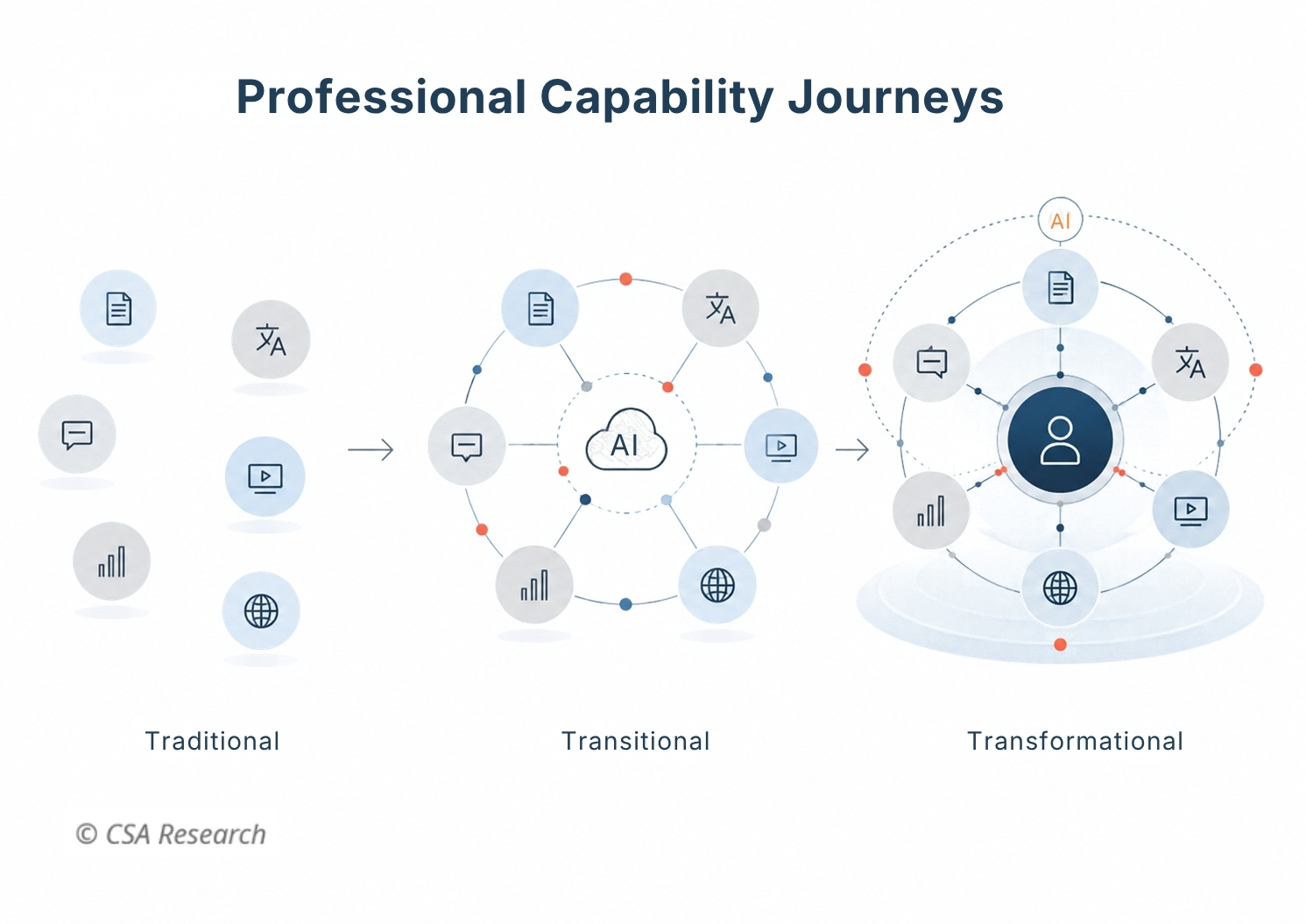
Customer needs come first, then workflow and resources, then people and technology, and finally accountable outcomes. I would argue that this order matters more than any specific tool choice. Technology generally creates the most value when it extends and responds to what customers actually need. On the other hand, it creates the least when it becomes the starting point for a decision that it cannot actually make.
What Actions Should Language Company Leaders Take?
The survey and our research point to four steps language companies can take to position themselves on the upward arm of the K-shaped economy:
1.Focus on profitable growth over volume. In a market where 44% of respondents saw revenue fall, chasing volume at thin margins only makes a company more fragile rather than less. Growth that does not cover the cost of delivering it simply moves the problem into next year, and it may make that problem bigger.
2.Build defensible expertise. Capabilities that are difficult to replicate, such as interpreting in scarce languages or modalities, or deep knowledge of a regulated sector, generally hold their value better than services that any competitor or tool can offer at a lower price. Expertise of this kind takes time to build, which is precisely what makes it hard for others to copy.
3.Build differentiation on talent and operational capacity. The survey points to rising demand in exactly the roles where recruiting is hardest. Companies that recruit, train, and retain the people – and build the processes – needed to serve that demand reliably are potentially in a position to win work that others have to turn down.
4.Use technology to solve real problems, not just because it is there. Applying AI or automation without a clear customer outcome adds cost and risk without adding much else. However, applying it where it demonstrably improves speed, quality, or price for a specific client creates value that the client can see and is likely to pay for.
The message to take away is discipline, not retreat. A harder market raises the cost of weak margins, undifferentiated services, thin capacity, and technology adopted for its own sake. Previously, companies could rely on a rising market, but today they need to make their own growth.
The good news is that success is not out of reach. Expertise, customer relationships, capacity, and purposeful technology are all levers that companies can control, even when market conditions are unfavorable.
FAQ: Questions Leaders Are Asking About the ALC Survey
Is the language services industry declining?
Partially. Among the 84 companies that answered the 2026 ALC Annual Survey, 44% reported declining revenue in 2025. However, 38% grew and 18% were stable, so the survey shows a market under uneven pressure rather than one in uniform decline. CSA Research’s other research shows overall declines in industry revenue consistent with this picture.
Where is demand strongest?
Demand appears strongest in institutional markets and in roles where specialized expertise is hard to replace. Respondents highlighted institutional buyers (76% of their revenue on average), interpreting, and scarce AI, data, and technology talent.
How is AI affecting language companies?
AI is influencing which services companies offer, which roles they expect to need, and how they design workflows. However, it has not created one standard operating model: Only 6% of respondents default to post-editing, while the rest weigh factors such as budget, quality, and turnaround.
What should language companies do with these findings?
The survey suggests that companies look closely at profitable growth, specialization, operational capacity, customer relationships, and purposeful use of technology. The right mix will likely depend on each company’s economics, capabilities, and market position.
After obtaining a BA in linguistics in 1997, I began working for the now-defunct Localization Industry Standards Association (LISA), where I headed up standards development and worked on quality assessment models. At the same time, I completed a...
CSA Research materials are copyrighted and provided solely to authorized users.
You are prohibited from submitting any CSA Research content to
generative AI tools, machine-learning systems, public or shared platforms, or any service
capable of storing, training on, or redistributing the material. You may not copy, record,
share, translate, or upload any portion of this content beyond your licensed rights
Unauthorized use, disclosure, or distribution may violate applicable laws. For
permissions or to report misuse, contact legal@csa-research.com.
We use cookies and similar tracking technologies to analyze site traffic and understand how you interact
with our website. This includes using tools to capture behavioral metrics and heatmaps so we can improve our
site design. By clicking 'Accept', you consent to this tracking. You can learn more in our Privacy Policy.