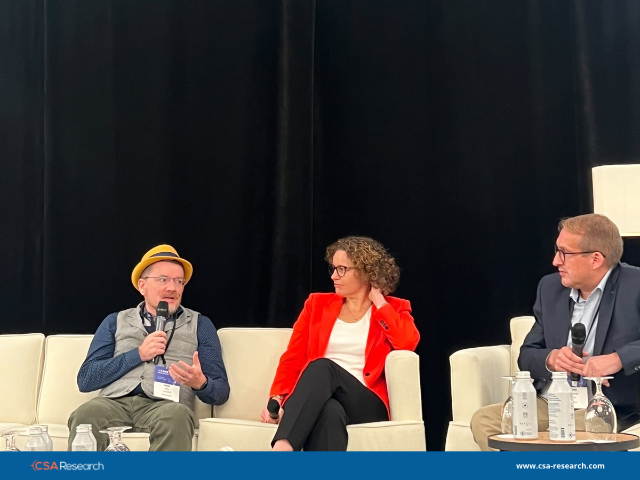
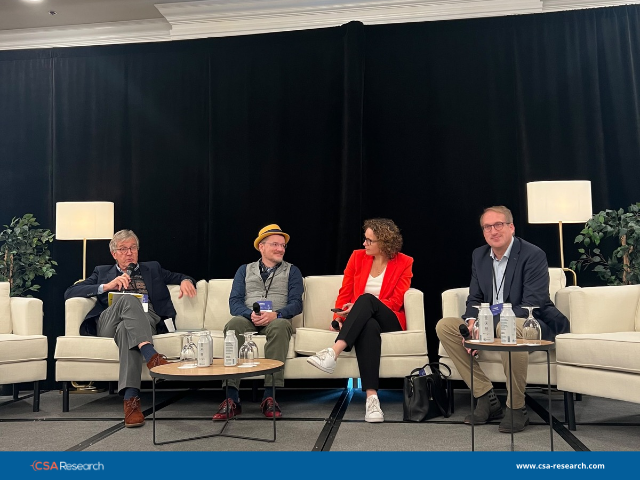
CSA Research’s Arle Lommel joined Henning Hinz (t’works) and Sophie Krishnan (Lokalise) on stage, with TAUS’s Jaap van der Meer moderating.
Key takeaways
-
Pure translation companies are a hard sell to investors right now. Capital goes to firms with something that sets them apart: technology, a credible AI position, deep specialization, or interpreting.
The TAUS Conference in Vancouver (14–16 October 2026) opened with a blunt question: If AI is automating the work that translators, interpreters, and writers have done for decades, why would anyone commit capital to the language industry? I joined Henning Hinz, CEO of t’works Group, and Sophie Krishnan, CEO of Lokalise, to discuss it, with Jaap van der Meer of TAUS moderating.
So, is the language industry still worth investing in? The honest answer is that right now it is tough, and we expect continuing challenges. Even so, there are real pockets of opportunity, and I would argue that the companies that survive the current disruption will likely find a better investment environment once it shakes out. TAUS’ decision to open with this topic framed why the technology discussions that followed mattered: technology is what will drive investment.
What Attracts Investors to the Language Industry Today?
In a word, differentiation. The consensus on stage was that you generally would not invest in a pure translation company as such, at least not a translation-centric language service provider (LSP) expecting the kind of gains the industry saw in the past. A buyer might still pick one up opportunistically to add capacity or clients. However, an LSP with, for example, a large, stable base of life sciences clients and real specialization could be a different story.
Money is more likely to go to companies with a technology play, companies that can credibly position themselves as AI companies, and interpreting providers, since interpreting continues to grow. Right now, technology is what attracts investors. Over the longer term, I would argue that access to talent will matter just as much, because the people with real expertise are the scarcest asset in the chain.
The longer-term case rests on what economists call “Jevons paradox”: When something becomes cheaper to produce, total demand for it can grow so much that overall spending rises. As the cost of translation falls, we expect demand to rise enough that more money will be earned from language overall. The rub is that it will likely not be earned by today’s companies in their current form, but by new entrants that disrupt the market or by incumbents that reinvent themselves.
Why Have Language Industry Valuations Fallen So Far?
The mood in the room was somewhat anxious, and with reason: Everybody recognizes that the industry is contracting – or by some accounts, not growing as quickly as in the past – right now, and valuations are far lower than they were even a year ago. We discussed that offers companies rejected as insultingly low a year ago are ones they would be glad to receive today; the problem is that hardly anyone is willing to pay for anything.
The panel discussed RWS’s agreement in August 2026 to acquire Acolad for £22.4 million (€26 million) – roughly two times EBITDA – as one factor pushing multiples down. This is for a business RWS expects to contribute roughly £155 million in annual revenue. Even though Acolad was a distressed property, with unsustainable debt pressure, which helps explain the price, deals like this inevitably will become reference points for everyone else.
The contrast with AI start-ups is striking. AI companies with almost no revenue and no immediate prospect of profitability can command very high valuations, while profitable translation companies with steady revenue streams get almost none. Positioning, in other words, matters more than the revenue itself.
Industry valuations have arguably long been higher than the underlying business justified, which created a perception among freelancers that somebody, somewhere, was making piles of money off their work. The reality is that the money simply is not there, at least not anymore. In a market where revenue is going down, the play has to shift to demonstrating profitability, which is a different thing than growing revenue.
Consolidation or Technology: Where Is the Industry Heading?
The industry is headed for both consolidation and a more technology-focused offering, although for different reasons. Everybody agreed that consolidation will continue, partly because there are so many distressed companies that need to sell. The difficulty is closing. Facts on the ground change so fast that even a slight delay in completing a deal often leads one side to walk away, because what looks attractive today may look very different three months from now.
On the other hand, the cost of a credible AI play has also collapsed. Two to three years ago, LSP CEOs told us that they required investing at least US$1 million a year in research and development. However, what that money bought then can essentially be had for US$10,000 today, although building your own model is a different matter and remains far more expensive.
Whether companies need to build their own models at all is still an open question. Many in the industry see it as not worth the cost, but I would argue it can be a differentiator, particularly since we know of companies that build or customize per-customer models to improve quality and set themselves apart.
Where Does Value Move When AI Does the Translating?
Value is moving to the outcome the client actually wants. Nobody wakes up in the morning and decides to buy translation; they are always buying something else through translation, so the value proposition has to move to that something else. If you want to be attractive to investors, you need to show that you move a meaningful needle for your clients. CSA Research’s ROI-driven solutions series, our work on quality as risk management, and our research on assessing the value of localization all deal with this shift.
Sales is changing in the same direction: it is moving toward relationship-based approaches and away from the old procurement-driven model. When CSA Research started talking about “consultative sales” a year or two ago, this was novel; now it seems everybody sees it as the only way forward, and any company that wants to succeed needs technical capability involved in the sales cycle.
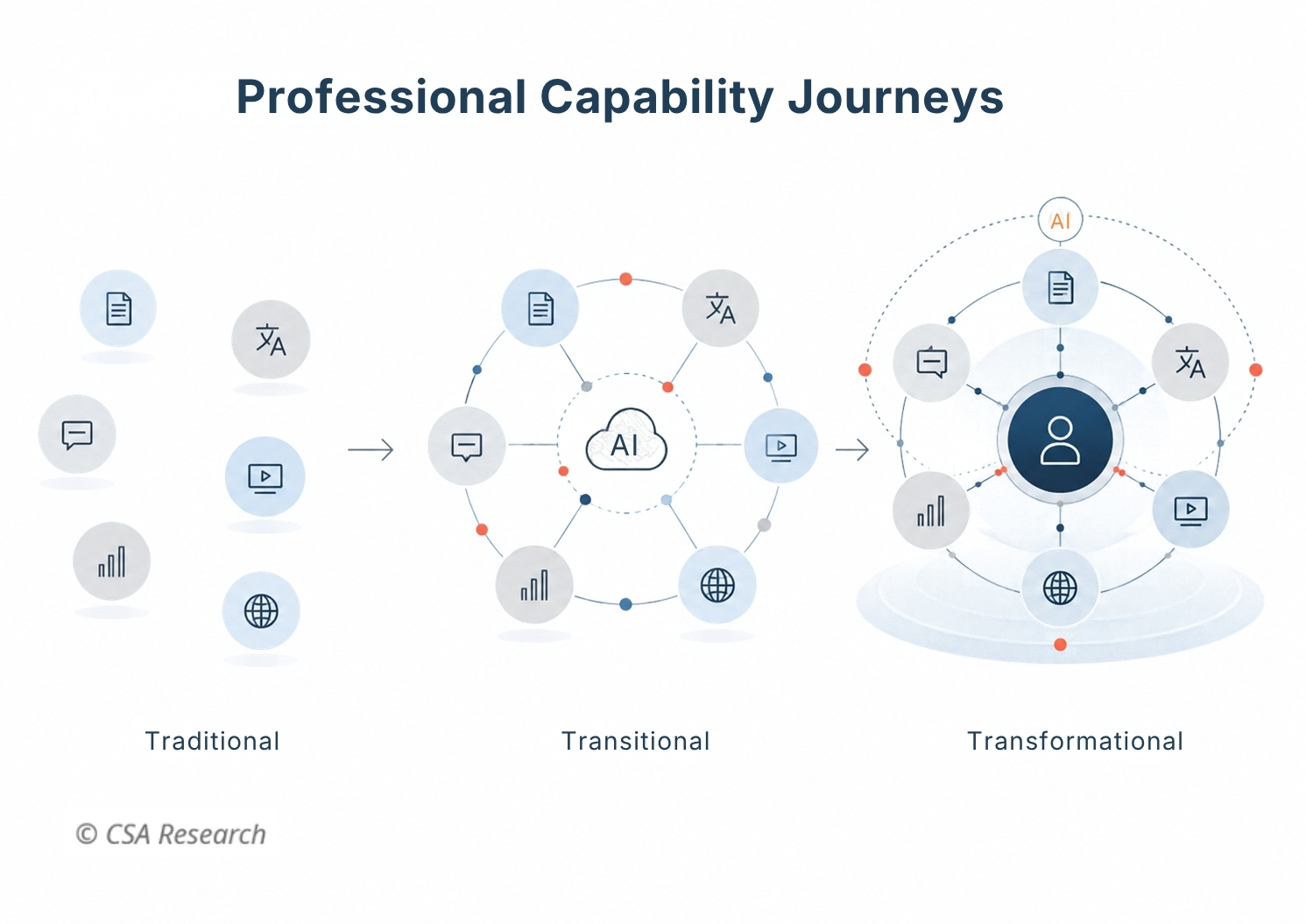
There was also complete agreement that expertise will become the differentiator. The bad news is that nobody quite knows yet how to make that pay, and there was more talk about paying linguists better than there were plans for doing so. Donald A. DePalma’s new CSA Research report on Professional Capability Journeys for the Transformational Enterprise addresses this question directly.
How Should Buyers and Sellers Approach M&A Right Now?
M&A should start with an alignment of maturity, for a start. A successful merger generally requires the acquirer and the acquired company to be similar in operational maturity; otherwise, you are likely to find such different operational cultures and capabilities that integration causes chaos. CSA Research’s Metrix 2.0 capability model is one way to assess that fit before a deal closes.
CSA Research’s M&A practice works from a simple premise: An acquisition needs to help a company build the capabilities it will need for its future business, not just add revenue, which is why we start with the company the buyer wants to become. In our experience, buyers remain active but selective, scrutinizing business quality, future demand and strategic fit, while sellers need credible evidence of their value. Whether it is a buyers’ or a sellers’ market depends on the business, because a generalist provider under pressure faces very different conditions than a company with differentiated expertise, strong customer relationships or valuable technology.
Valuation is where expectations most often diverge. A headline multiple (including the RWS–Acolad figure above) says little on its own without an understanding of the earnings and deal terms behind it, and a valuation needs to reflect business quality, future earning potential, and strategic fit. A low price alone does not justify a deal. Preparation also generally matters more than size in how long a deal takes, and establishing an indicative valuation range early helps reveal expectation gaps before they cause avoidable delays, which is particularly important in a market where deals die in delay.
Both sides can likely avoid “deal remorse” by doing the hard work before signing. For buyers, that means confirming strategic fit and planning integration in advance, since acquiring a company also means acquiring its problems. Sellers generally weigh price, payment terms, and confidence that the buyer can close (and, for founders who stay on, their future authority), so they need to clarify expectations about control, future roles, and the transition early; a planned exit tends to produce better decisions than a sale driven by fear. (If you need help in establishing your valuation, talk to us about our due diligence services.) Culture and chemistry are essential throughout, because both parties need to agree on the future business, leadership roles, and integration approach, and employees need to understand where they fit.
Smaller companies (those under US$1 million in revenue) are sometimes easier to acquire, although founder dependency, incomplete records, and customer concentration can complicate those deals, and preparation and strategic fit remain just as important.
What It Means for LSPs, Buyers, and Investors
-
LSP owners: Now is a bad time to sell, because you will not get the valuation you want. However, if your value rests purely on transactional translation, it is not going to get better on its own. To improve your valuation, you need something that differentiates you and is defensible and interesting to investors.
-
Enterprise buyers: Buyers need to watch their vendors’ stability and ask how those vendors will ensure access to the talent they need, given how many people are leaving the sector. Consolidation is unlikely to affect pricing and choice much, because the industry remains highly fragmented: Even the largest provider holds less than 5% of the market.
Looking Ahead: What Would Get Investment Moving Again?
The implication for deal-making is clear. Any deal made purely for translation capacity is unlikely to deliver, even if it does not fail outright, and companies without a technology play will likely find it increasingly hard to attract investment.
What would it take to get investment moving again? The answer likely lies in a concept from economics called “regime uncertainty”: When investors cannot predict the rules, regulations and conditions that will affect them, they hold back for fear of misinvesting if the ground shifts. Until that uncertainty eases, I do not expect investment to free up. The good news is that there is still opportunity. The bad news is that the investors who pursue it will ask much harder questions, and the companies that can answer them are the ones that will be standing when the market recovers.
Considering a merger, acquisition, or exit? CSA Research helps clients define what an acquisition needs to achieve and prepare to realize its value, combining our Metrix 2.0 capability assessment with transaction preparation, early integration planning, and strict confidentiality.
Related R
Frequently Asked Questions
Is the language industry still a good investment in 2026? Selectively. Panelists at TAUS Vancouver 2026 agreed that translation-centric language service providers are unattractive investments today, while companies with technology, a credible AI position, deep specialization, or interpreting services can still attract capital. Investors are applying closer scrutiny, and the longer-term environment is expected to improve for survivors.
Why are language services company valuations falling? Revenue across the translation portion of the industry is declining as AI automates translation. Buyers are cautious, and conditions change so quickly that deals often collapse during delays. Low-priced transactions, such as RWS’s agreement to acquire Acolad at about two times adjusted EBITDA, also reset expectations for other sellers.
What did RWS pay for Acolad? In August 2026, RWS agreed to acquire Acogroup, Acolad’s parent company, for an enterprise value of £22.4 million (€26.0 million). Reports put the price at about two times Acolad’s expected adjusted EBITDA, for a business RWS expects to contribute about £155 million in annual revenue.