Your Sales Team Was Trained to Sell Translation. The Market Now Expects More.
Peter Coleman
July 16, 2026
When I began developing CSA Research’s ROI-Driven Solutions for Global Content, I expected the hardest part to be defining the offerings.
It wasn’t.
The more difficult question was: Who is prepared to sell them?
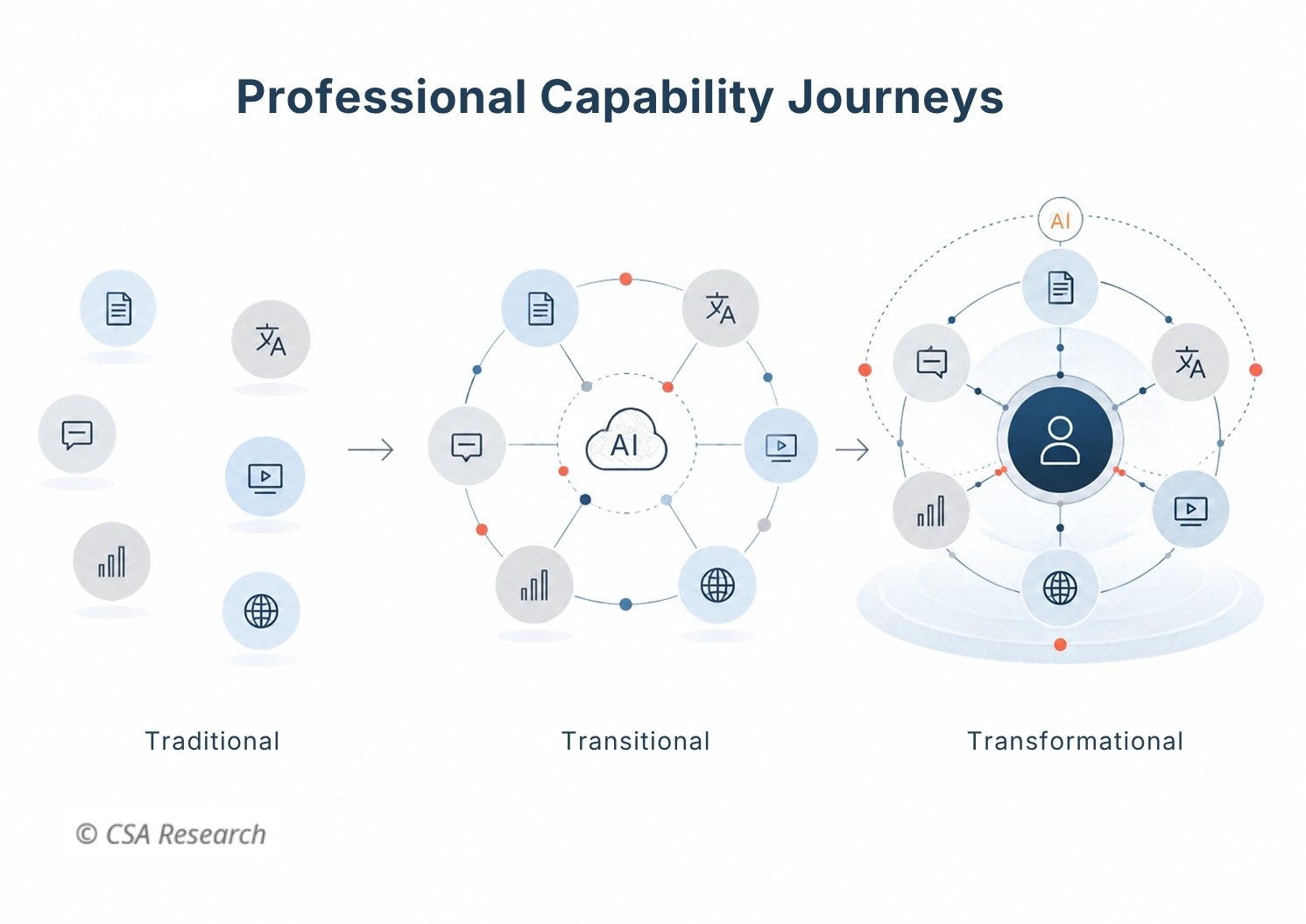
Across the language services industry, providers are investing in capabilities that extend far beyond traditional translation. They are developing solutions connected to AI, compliance, customer experience, global content operations, data, technology, market expansion, risk, and business process support.
Yet when those solutions reach the market, many sales conversations return to familiar ground: quality, turnaround time, cost per word, translation memory leverage, language coverage, and delivery capacity.
These measures still matter. They help organizations operate effective localization programs. But they do not explain the business value of a more strategic solution.
That gap became the catalyst for CSA Research’s Post-Localization Sales Workshop.
The offering has changed faster than the sales motion
Many LSPs know they need to move beyond transactional services.
They have watched AI reshape production models, buyer expectations, and the economics of traditional translation. They understand that competing only on price, speed, and linguistic quality creates an increasingly difficult commercial position.
In response, providers are building new offerings. The problem is that the way those offerings are sold often has not changed nearly as much.
A company may have developed a sophisticated AI governance service, multilingual content operation, compliance solution, customer experience offering, or global workflow capability. But its sales team may still introduce that solution through the language of localization delivery.
This creates a disconnect: the provider sees a strategic solution; the prospect hears a more complicated translation service.
CROs are frustrated—and understandably so
I hear a consistent concern from chief revenue officers and other commercial leaders.
They want marketing, sales, business development, and account management teams to elevate the conversation. They want commercial teams to explain why a solution matters to the client’s business. They want stronger prospecting into organizations with multilingual content problems that may not yet be defined as localization opportunities. They want access to buyers beyond the traditional localization function. And they want sellers to engage executives around business impact, outcomes, investment, and value.
But two gaps repeatedly get in the way.
The first is value articulation. Many sellers can describe what their company delivers. They struggle to explain why the organization should invest in it.
The second is opportunity recognition. Many teams still search for prospects that need translation. They are less prepared to identify companies dealing with broader challenges involving multilingual customers, products, employees, data, content, compliance, or operations.
Neither problem is solved by producing another capability deck. And neither disappears because leadership tells the sales team to “be more consultative.”
The industry is asking sellers to do something they were never taught to do
That is the uncomfortable part of this conversation.
The problem is not that LSP salespeople lack intelligence, ambition, or motivation. The problem is that many have been trained for a different market.
For years, the industry normalized a particular commercial vocabulary. Sellers learned to talk about words, rates, quality, service levels, workflow efficiency, technology, and delivery. Those were the measures buyers used. They were the basis of procurement exercises, supplier comparisons, and account reviews.
Now the same sellers are being asked to discuss revenue growth, customer retention, market expansion, AI risk, regulatory exposure, employee productivity, brand consistency, operational scalability, customer experience, and return on investment.
That is not a small adjustment to an existing pitch. It is a different kind of business conversation.
Commercial leaders often recognize the need before their teams feel prepared to meet it. The result is frustration on both sides: leadership sees missed opportunities, while sellers feel pressure to operate at a level for which they have received little practical preparation.
This is where the human role becomes more important—not less
AI can help a seller research a company, summarize its strategy, identify public signals, draft outreach, or organize account information. Those capabilities are valuable. They can improve preparation and reduce time spent on routine work.
But AI does not remove the human factor from selling. It makes that factor more important.
A meaningful consultative conversation still depends on judgment. It depends on knowing which issue may matter most to a particular buyer. It depends on curiosity rather than interrogation. It depends on hearing the concern behind the stated problem. It depends on recognizing when a prospect is uncertain, unconvinced, defensive, or ready to explore something more significant.
It also depends on connecting what is happening in the organization to a business outcome that people genuinely care about—and on earning trust.
The seller’s role is not simply to transfer information. Prospects can obtain information without speaking to a salesperson. The seller’s value lies in helping the buyer understand the problem more clearly, see implications they may not have considered, and make a more confident decision.
That remains profoundly human work.
Better business understanding creates better sales opportunities
The strongest commercial conversations do not begin with the provider’s capabilities. They begin with the client’s business.
A company may be entering new markets, integrating an acquisition, introducing AI, redesigning its digital experience, expanding a partner ecosystem, launching a new product, reducing headcount, or responding to new regulatory demands. Each change may create multilingual content complexity. But the buyer may not call it a localization problem.
The opportunity becomes visible only when the seller can understand what is happening, recognize the possible business impact, and engage the right people in a relevant conversation.
This changes more than the opening pitch. It improves the quality of prospecting. It creates stronger executive relevance. It helps sellers move beyond operational contacts without dismissing the importance of those relationships. It makes discovery more useful because the conversation is based on the client’s priorities rather than the provider’s service catalog.
It also makes ROI more credible. A financial model is only persuasive when both parties agree on the problem, the impact, and the value of improving the situation.
From translation vendor to business partner
Nearly every LSP says it wants to be viewed as a strategic partner. That status cannot be claimed in a tagline. The client decides whether the provider is a vendor or a partner based on the value of the relationship.
A vendor responds to defined demand. A partner helps the client understand what demand should exist. A vendor explains capabilities. A partner connects expertise to the client’s business priorities. A vendor waits for a project. A partner recognizes a developing problem and earns the right to discuss it. A vendor measures success through delivery. A partner also understands the business outcome that delivery is intended to support.
The goal is not to abandon translation or pretend every salesperson must become a management consultant. The goal is to help commercial teams elevate what they already know.
Language service providers possess deep expertise in global content, language, culture, technology, workflow, and international operations. That expertise becomes more valuable when sellers can connect it to the business problems their clients are trying to solve.
What participants should gain from this workshop
The Post-Localization Sales Workshop is designed for salespeople, business development professionals, account managers, customer success leaders, and commercial executives who know the market has changed and want to respond more effectively.
Participants should leave better prepared to recognize business developments that may create multilingual content opportunities; prospect beyond organizations already searching for translation; engage a broader range of business and executive stakeholders; explain the business value of newer, more strategic offerings; approach sales conversations with greater relevance and confidence; connect multilingual content problems to measurable business outcomes; contribute to stronger business cases and investment discussions; and position their organization as a partner rather than another interchangeable supplier.
This workshop does not rely on generic sales theory detached from the realities of this industry. It is grounded in the commercial challenges LSPs and GCSPs face as they attempt to evolve beyond traditional localization services.
Participants bring real accounts, real opportunities, and real commercial questions. They leave with a stronger way of thinking about the market and their role within it.
The market does not need another translation pitch
The language services industry is not running out of opportunity. It is running out of room for undifferentiated selling.
Organizations still have enormous multilingual content needs. In many cases, those needs are becoming more complex as AI increases content volume, companies expand globally, regulations multiply, customer expectations rise, and operating models become more distributed.
But providers will not capture those opportunities by waiting for buyers to issue another translation RFP.
They need commercial teams that can see the wider business problem. They need sellers who can understand what the prospect is trying to accomplish, articulate why multilingual content matters to that objective, and help the buyer evaluate the value of solving it.
They need people who can combine technology-assisted insight with human curiosity, credibility, and connection. Most importantly, those people need to be taught how to operate in the market that now exists.
That is why I created the Post-Localization Sales Workshop.
Registration is now open
Registration is now open for the next program. Join CSA Research and prepare your commercial team for the business conversations that will shape the next era of language services.
CSA Research materials are copyrighted and provided solely to authorized users.
You are prohibited from submitting any CSA Research content to
generative AI tools, machine-learning systems, public or shared platforms, or any service
capable of storing, training on, or redistributing the material. You may not copy, record,
share, translate, or upload any portion of this content beyond your licensed rights
Unauthorized use, disclosure, or distribution may violate applicable laws. For
permissions or to report misuse, contact legal@csa-research.com.
We use cookies and similar tracking technologies to analyze site traffic and understand how you interact
with our website. This includes using tools to capture behavioral metrics and heatmaps so we can improve our
site design. By clicking 'Accept', you consent to this tracking. You can learn more in our Privacy Policy.