Few questions about artificial intelligence (AI) get asked as often – or answered as unhelpfully – as whether it will replace the people who currently do the work. Large language models (LLMs) have given the question new urgency in the language sector, where machine translation (MT) has been part of everyday production for years, because they produce text that reads as if someone who understands the subject wrote it.
I would argue that the replacement question, however it is answered, is the wrong one. It frames the relationship between people and AI as a contest over who does the work, when the more consequential questions are who decides what the work is for, who judges whether it is good enough, and who answers for the result when it is not. Those are questions about authority and accountability rather than throughput, and they do not go away just because a model can generate a fluent draft in seconds.
“Human in the Loop” Sounds Reassuring, but It Puts People in the Wrong Place
The usual compromise is to keep a “human in the loop.” The phrase, however, describes a specific arrangement: The machine does the bulk of the work, and a person is inserted near the end to check and correct it. Translators know this arrangement as MT post-editing, and a common complaint is that they end up fixing the same mistakes again and again with little ability to prevent them (generally at a reduced rate, too).
The rub is that the person in the loop carries responsibility for the outcome without much control over how it is produced. A process designed this way treats expertise as a quality-control cost to be minimized rather than as the thing that makes the output trustworthy, and it makes the reviewer the obvious target for blame even when the error was baked in long before they saw the text.
Fluency Is Not the Same Thing as Judgment
This matters more now because of how LLMs produce text. A model predicts, one token at a time, what is most likely to come next given its training data and the context in the prompt, so its output is often remarkably fluent – fluency is essentially what the mechanism optimizes for. However, likelihood is not knowledge: The model cannot know that your legal team approved a different term last quarter, that a phrase carries an unfortunate connotation in one market, or that a particular sentence creates regulatory exposure in another. Left to itself, it will generally reach for the most common answer rather than the right one for your organization (which is one way a carefully differentiated brand ends up sounding like its competitors in other languages).
Perhaps more concerning, the errors arrive in the same polished prose as the correct output, so they are far harder to spot than garbled MT ever was, particularly for readers who cannot check the source. Producing fluent text can now be automated reasonably well for many languages and content types: setting objectives, deciding how good a given piece of content needs to be, interpreting cultural context, assessing risk, and taking responsibility for the result – at least not with the technology available today.
Putting People at the Core Changes What AI Is For
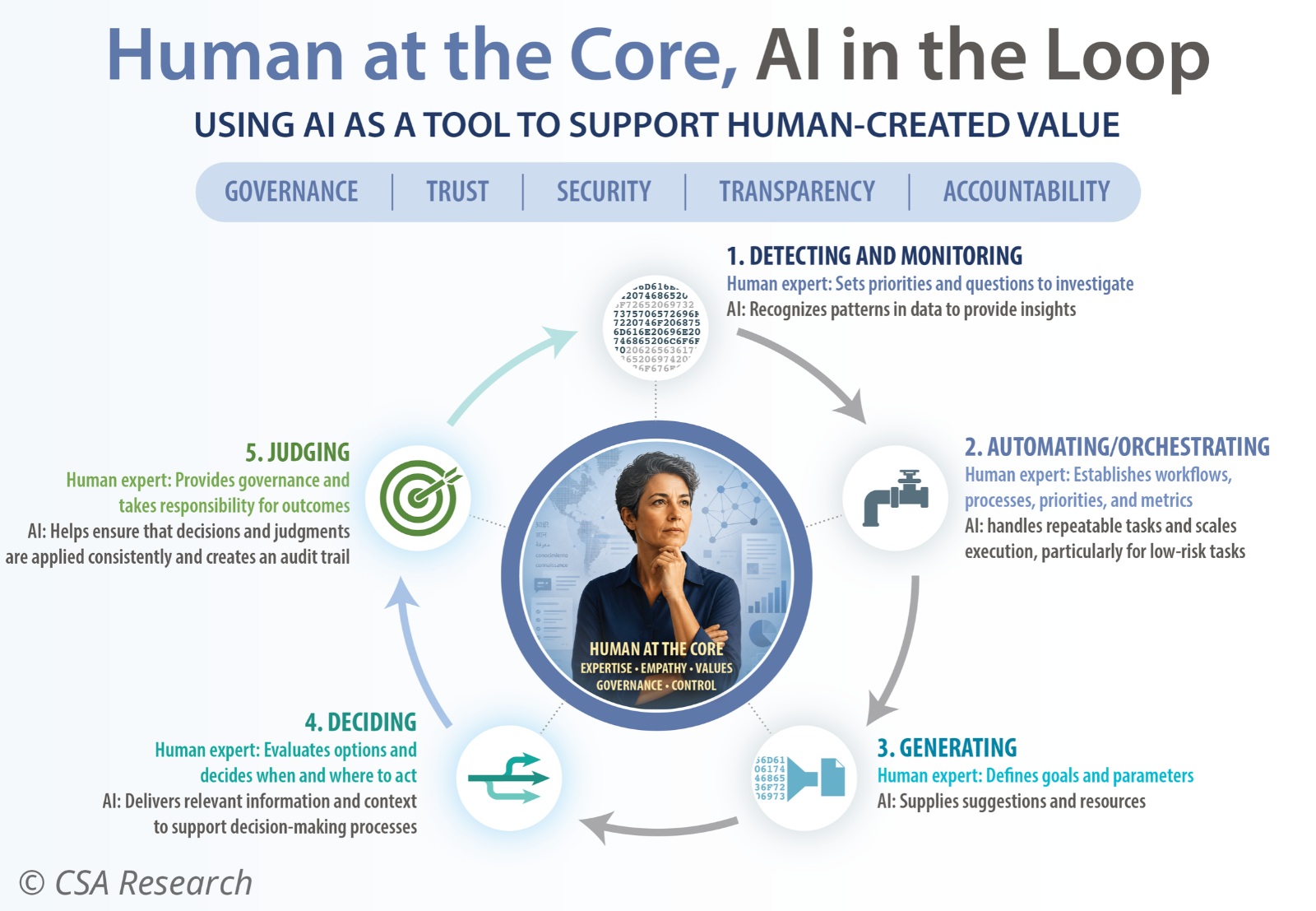
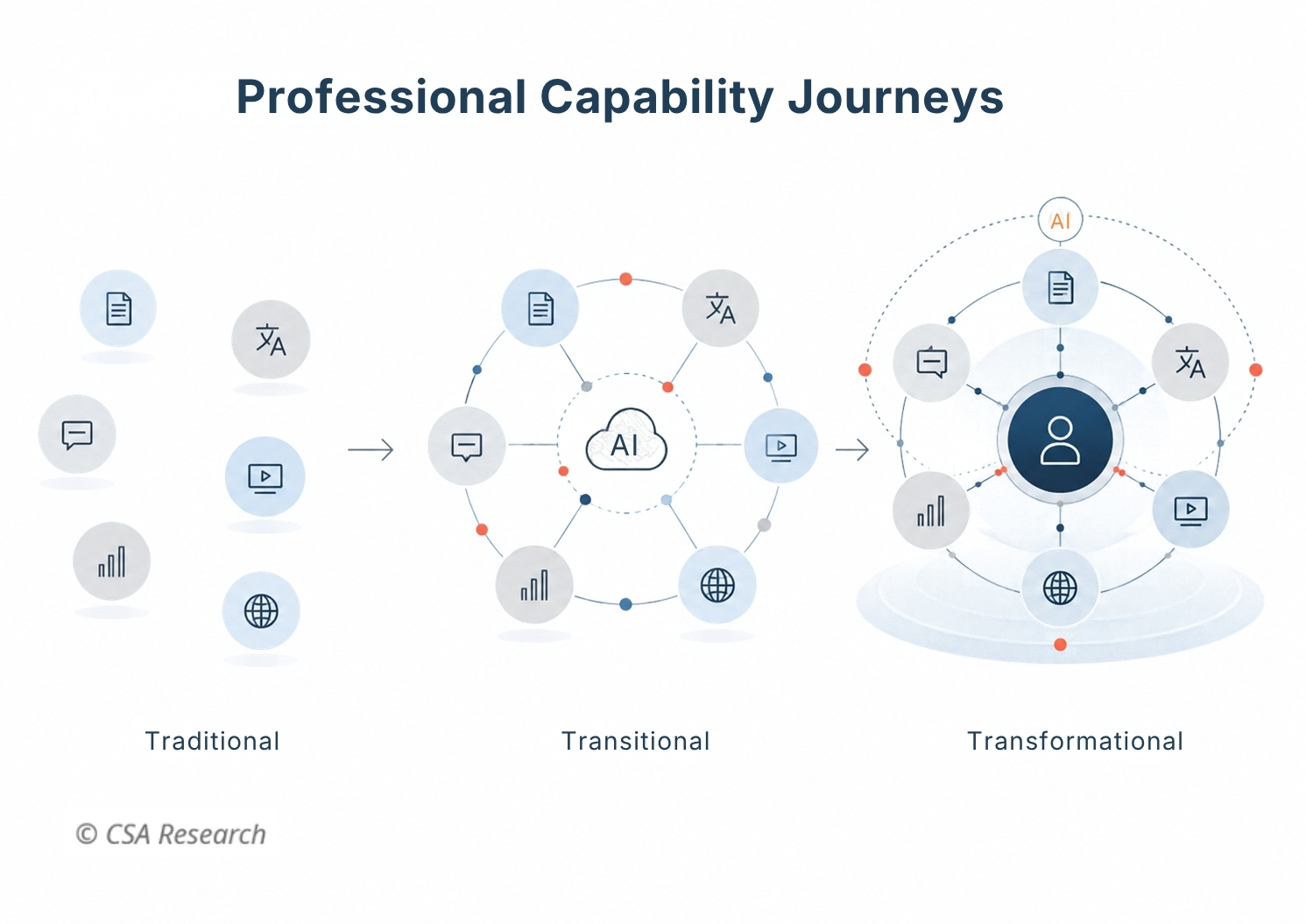
CSA Research’s answer to this problem is a concept we call Human at the Core, AI in the Loop. The name is a deliberate inversion. Instead of inserting people into an AI workflow to clean up after it, the concept puts them at the center: They define what the work needs to achieve, exercise the judgment it requires, and remain accountable for the result, while AI works within roles they define. The idea is not new to us (we first described it in 2016 as “augmented translation”), but LLMs have made it considerably more urgent.
An everyday analogy may help. Commercial airliners spend much of a typical flight under automated control, yet nobody describes the captain as the “human in the loop.” The pilots decide where the aircraft is going, set the parameters the automation works within, and take over when conditions demand it. The automation makes the flight more efficient, but authority and responsibility never leave the flight deck.
In practice, the difference is less about which tools an organization uses than about which way the help flows. In a human-in-the-loop process, the machine hands its work to a person for inspection. In a human-at-the-core process, technology works on the expert’s behalf, and the expert spends less time fixing and more time deciding.
Organizations Need to Rethink the Arrangement, Not Just the Tools
Many organizations approach AI adoption as a procurement decision: Pick a model, connect it to the content pipeline, and calculate the savings. However, the same tools can be deployed in ways that strengthen expertise or hollow it out, and that choice is organizational rather than technical. At least three reasons make the arrangement worth revisiting before it hardens into habit:
-
Accountability cannot be delegated to a model. When a product label, a patient leaflet, or a contract clause goes wrong in another language, someone in the organization will have to answer for it. A model cannot be held responsible, and a reviewer who saw the text only after the fact is poorly positioned to do so. Processes that leave accountability with people who have no control over the work are essentially setting them up to fail.
-
Clean-up work spends expertise on the least valuable part of the job. Experienced linguists and subject-matter reviewers are expensive precisely because they know things the model does not. Using them mainly to correct recurring machine errors wastes that knowledge, and the organization may well pay for the same corrections again on the next project.
-
Better models make end-of-line review harder, not easier. It seems intuitive that more capable models reduce the need for human involvement. Potentially, but more fluent output also hides its remaining errors better, which shifts the value of expertise from catching problems at the end to shaping the work from the start.
None of this is an argument against automation. Plenty of content can flow with little human involvement when the stakes are low. The larger point is that deciding where human judgment belongs is itself a judgment, and one that people need to make deliberately rather than inherit from whatever a tool’s default workflow assumes.
The Question Is No Longer Whether AI Participates
AI already takes part in much of the multilingual content produced today, and the language sector – which has had more practice than most at absorbing automation – is simply meeting this question earlier than other fields where capable AI meets expert decision-making. The good news is that the technologies needed to put people at the core, which were little more than glimpses when we first described augmented translation, are now in production use. The bad news is that technology alone does not determine the outcome: Organizations that treat AI primarily as a way to cut costs will likely build processes that consume expertise rather than build on it, and they may not notice the consequences until something goes wrong in a market whose language they cannot read. Those that rethink the relationship first are likely to find that people and AI together can do what neither manages on its own.
What it takes to make the shift – which technologies matter and how they have changed, where expert attention pays off, and what providers, enterprise buyers, technology developers, and linguists each need to do differently – is the subject of “Human at the Core, AI in the Loop”). It lays out the evidence and the recommendations behind the argument made here, and it is the place to start for anyone deciding how people and AI will work together in their own organization.