Home > Blogs & Events > Blogs
Nearly six years ago, CSA Research posted blogs on two M&A transactions: “RWS Acquires SDL – The Technology Story” and “Acolad Acquires Amplexor.” At the time we analyzed those two acquisitions in the context of our 2016 “M&A in the Language Sector” report which forecast the coming years of mergers and acquisitions in the sector. This brief reviews those acquisitions and that report in the context of this week’s purchase of Acolad by RWS – and how that fits into the evolution of demand and supply for global content operations.
The RWS–Acolad transaction fits the framework CSA Research established in 2016, but the strategic center of gravity has shifted substantially. That report identified the enduring reasons companies acquire language-sector firms: growth, geographic expansion, new services, production capacity, technology, intellectual property, talent, and access to attractive verticals. It also emphasized that cross-border acquisitions often combine geographic expansion with vertical or service specialization.
RWS–Acolad checks nearly every one of those boxes:
Geographic expansion: RWS gains substantially more coverage in Western Europe.
Client acquisition: Acolad brings relationships with approximately half of the CAC 40.
Vertical expansion: Roughly half of Acolad’s revenue comes from regulated industries, including medical devices, which complements RWS’s pharmaceutical strength.
New services: Acolad adds an established interpreting capability.
Cross-selling: RWS expects to offer its Generate, Transform, Protect, and AI platforms to Acolad clients.
Scale: The combination broadens the revenue base over which RWS can fund platform development and deployment ("RWS agrees to acquire Acogroup," London South East).
The basic acquisition logic has not changed since our 2016 analysis. All those themes remain visible in the current transaction. Our 2016 analysis was also prescient in several other respects. It anticipated:
Increasing private-equity involvement
Acquisitions becoming a formal strategic function
Scarcity of differentiated targets in attractive verticals
Technology and content companies becoming more important participants
Carve-outs and restructurings when an acquired business no longer fit its owner or capital structure
The risk that M&A would fail to produce the expected combination of revenue and growth
The two September 2020 transactions now look like parallel experiments that led to very different outcomes.
RWS–SDL
The RWS–SDL analysis described a transaction that immediately transformed RWS from a predominantly services-oriented supplier into a leading language-technology company and a participant in structured content management. SDL brought translation management, translator productivity, machine translation, AI, web content management, and structured-content technology.
In retrospect, this gave RWS an asset base that could later be reframed around enterprise AI and content transformation. The technology portfolio was not automatically coherent or fully integrated, but RWS acquired the raw components from which it could build:
Language platforms
Enterprise content infrastructure
Machine translation and AI capabilities
Proprietary intellectual property
A much larger installed customer base
The 2026 Acolad transaction extends that strategy. RWS is no longer buying primarily to obtain technology. It is buying distribution for technology it already owns or is developing. That is an important evolution: SDL gave RWS platforms and products. Acolad gives RWS more customers in public sector, life sciences, and medical devices; interpreting capability; its LIA translation platform; and the European reach through which to monetize them.
Acolad–Amplexor
According to Acolad executives, the company successfully unified its acquisitions organizationally and technologically, built a common operating model, and maintained double-digit profitability despite a contracting market. Management believes Acolad entered the AI era from a position of operational strength but increasingly constrained financial flexibility.
The Acolad–Amplexor analysis identified a much more fundamental strategic tension. Acolad was characterized as an acquisition-driven translation agency, while Amplexor had positioned itself around global content, technology, knowledge-process services, digital experience, and compliance.
CSA Research questioned whether Acolad would transform itself by adopting Amplexor’s more advanced model or absorb Amplexor into its existing translation-agency structure. Our 2016 report was unusually explicit about the risk:
Acolad had grown through repeated acquisitions.
Integration across those acquisitions was described as uneven.
It lacked a unified technology foundation.
Amplexor brought stronger technology, global-content positioning, management, marketing, and enterprise expertise.
Acolad would need to accept lower near-term margins and possibly postpone its IPO ambitions to build a more differentiated global-content company.
Continuing as a commodity-oriented translation consolidator would leave it exposed to low-price competitors, machine translation, and increasingly automated delivery models.
The 2026 transaction suggests that Acolad did not fully resolve that tension. It did build a large European business and retained meaningful regulated-market and enterprise strengths. However, RWS’s rationale values Acolad primarily for its:
European client base with a growing North American presence
Regulated-industry footprint in public sector, medical device, and life sciences
Interpreting capability – where Acolad has made significant investment and has seen some notable successes
LIA translation platform that complements RWS technology
The major difference is the market environment. In 2016, we described acquisition as evidence of a healthy, growing, fragmented industry. Scale supported competitiveness, international expansion, and access to growing demand.
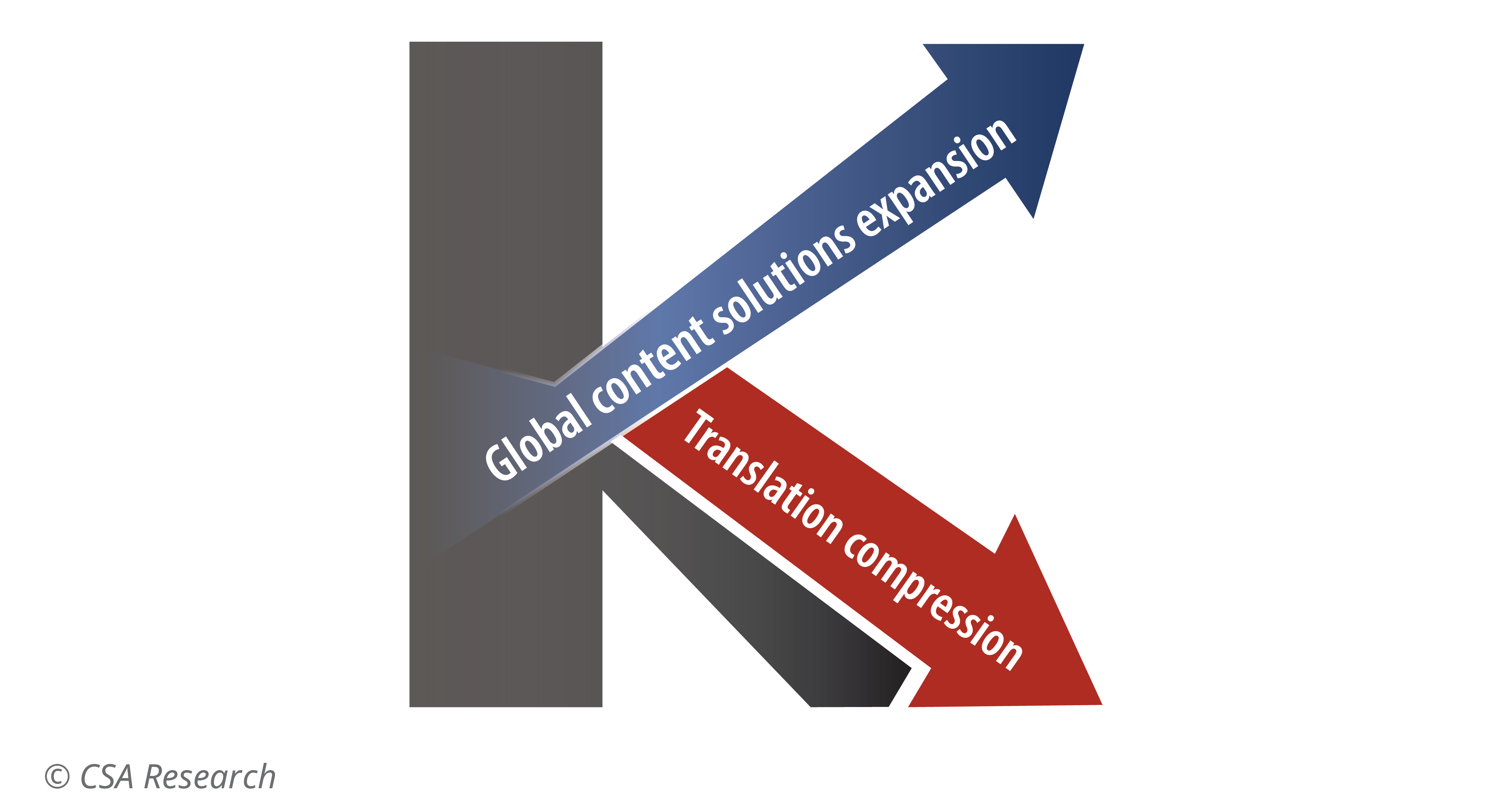
In 2026, scale alone is insufficient. The traditional translation market has been shrinking in real terms, pricing has compressed, and value has migrated toward broader content, technology, compliance, interpreting, data, and enterprise solutions. “The K-Shaped Language Sector” report documents a widening split between translation-centric providers and firms moving toward global-content solutions.
Therefore, CSA Research views this acquisition as strategic consolidation during structural market divergence rather than consolidation driven simply by sector growth.
The evidence strongly supports the debt hypothesis, although the public announcement does not explicitly describe Acolad as distressed. The most revealing feature of the deal is its financial structure. According to London South East, RWS is acquiring a company that reported:
£182 million in 2025 revenue
£13 million in adjusted EBITDA
£404 million in gross assets
An enterprise value of only £22.4 million
Total consideration of £40.2 million, including approximately £17.8 million of cash expected to be on Acolad’s balance sheet at completion.
That valuation is exceptionally low relative to revenue and assets. The enterprise value is approximately:
0.12 times 2025 revenue
1.7 times 2025 adjusted EBITDA
Approximately 2 times RWS’s forecasted 2027 adjusted EBITDA contribution from Acolad
An important aspect of the transaction is the treatment of debt. According to London South East, rather than taking on Acolad’s outstanding obligations to outside lenders, RWS will acquire the bonds issued by Acolad subsidiary V.O. Paris that are currently held by institutional lenders. After closing, those bonds will become an internal obligation within the RWS group and will ultimately be eliminated through financial consolidation. This structure allows RWS to acquire Acolad’s operations, customers, and capabilities without inheriting third-party debt, suggesting that resolving Acolad’s capital structure was a significant element of the overall transaction.
Public French corporate data for the Acogroup holding company indicates substantial financial debt over recent years, including reported financial debt of €219 million in 2021, €77.7 million in 2022, €83.4 million in 2023, and €41.7 million in 2024. These are holding-company figures rather than a complete consolidated view of the operating group, so they must be treated cautiously, but they support the conclusion that leverage was central to the ownership structure.
Acolad appears to have had little strategic or financial room to maneuver. The unusually low enterprise valuation, the treatment of its debt, and the exclusion of third-party obligations suggest that the transaction was shaped as much by its capital structure as by strategic fit. At the same time, company management characterizes the sale as a voluntary, competitive process rather than a creditor-driven restructuring.
The Financial Details Remain Behind the Curtain
The publicly available evidence does not establish or provide the details that we would look for in assessing a company – in this case, mainly for the company being acquired:
Whether Acolad breached a debt covenant
Whether it missed or deferred an interest payment
The original face value of the bonds
The losses, recovery rate, or concessions accepted by creditors
Whether a competitive sale process occurred
Whether shareholders received meaningful proceeds
While the available evidence points strongly toward capital structure as a decisive factor, the publicly disclosed information does not permit a definitive conclusion regarding the precise financial events that led to the sale.
This outcome also reflects the risk implicit in Acolad’s acquisition-led growth strategy. Our 2020 analysis noted that Acolad had grown rapidly by buying progressively larger companies and was attempting to combine numerous businesses while still developing a unified culture, brand, operating model, and technology foundation.
That model works while:
Capital remains inexpensive
Acquired revenue remains stable
Translation demand and pricing support debt service
Integration produces the expected synergies
Future refinancing remains available
It becomes fragile when:
Translation revenue contracts
Automation compresses prices
Interest costs rise
Integration remains incomplete
Revenue acquired at earlier valuations loses economic value
The company needs additional investment to transform its technology and operating model
The acquisition strategy did not necessarily create all Acolad’s problems, but it was a bet that made sense when it was taken but which appears to have left the company with less tolerance for the sector’s post-2019 deterioration.
Our K-shaped market analysis argues that value is migrating away from unit-priced translation and toward global-content solutions tied to customer experience, compliance, digital operations, governance, and enterprise outcomes. Translation remains necessary, but its economic value increasingly depends on its role inside a broader content system.
RWS acquiring Acolad is a supply-side response to that demand-side shift. Accordingly, RWS is not presenting the acquisition as a way to process more words at lower cost. Its rationale emphasizes:
AI platforms
Enterprise relationships
Multi-year contracts
Regulated markets
Medical devices and life sciences
Interpreting
Content transformation
Cross-selling among Generate, Transform, and Protect
Safe and responsible deployment of AI at global scale
RWS’s Strategic Logic
RWS has three principal assets to deploy:
Technology and intellectual property, much of it inherited from SDL and subsequently developed or repositioned.
Domain and regulated-market expertise, especially in life sciences and intellectual property.
A global enterprise platform, capable of supporting large multinational relationships.
Acolad contributes:
European enterprise distribution, especially in France and Western Europe
Approximately half of the CAC 40 as clients
Additional regulated-market exposure
Medical-device expertise complementary to RWS’s pharmaceutical position
Interpreting capability
A large operating base to which RWS can apply AI and automation
The acquisition yields platform plus channel, rather than simply provider plus provider.
AI Changes the Economics of the Acquisition
In our 2016 M&A model, purchasing another LSP primarily added revenue, production capacity, people, and accounts. In the emerging model, an acquirer with proprietary platforms can gain disproportionate value by distributing the same technology across a larger customer and operational base.
RWS explicitly states that it intends to bring its Cultural Intelligence Layer, Language Weaver Pro, and next-generation Transform platforms to Acolad’s clients. It also expects to apply its technology playbook across Acolad’s operations.
This produces two possible sources of return:
External monetization: Sell more RWS technology and AI-enabled solutions to Acolad customers.
Internal productivity: Apply automation to Acolad’s service delivery and improve margins.
That is the strategic upside. The downside risk is that “apply AI” becomes primarily a cost-reduction program for traditional translation operations. That could improve short-term EBITDA while leaving the combined company exposed to the downward arm of the K. The stronger strategic outcome would use Acolad’s relationships to create broader enterprise programs spanning content, language, compliance, knowledge, interpreting, and customer experience.
Adding the Transformational Imperative to the M&A Calculus
The acquisition responds to the changing nature of global demand that we chronicled in “The Transformational Imperative: Reframing Global Content” (TTI, for short) and the two decades of our research that underpin that framework:
Content appears across more channels and modalities.
Enterprises need to address more personalized motivations and experiences.
Sovereignty, regulation, security, jurisdiction, and cultural appropriateness increasingly shape deployment.
AI expands content supply while making governance, trust, context, and multilingual performance more difficult.
RWS’s stated strategy aligns with this demand structure. Its emphasis on cultural intelligence, regulated industries, secure AI deployment, content transformation, and global enterprise confidence is materially broader than a traditional localization proposition.
Acolad adds the continental coverage and client proximity required to operationalize that strategy at European scale. The significance of “more Europe” is therefore not merely geographic. Europe brings:
More languages
More regulatory environments
More public-sector and institutional customers
Greater sovereignty and data-governance requirements
Strong medical-device and life-sciences demand
More need for localized, jurisdiction-specific deployment of AI and content systems
In terms of the Transformational Imperative (TTI), RWS is buying additional capacity to manage the complications of sovereignty, channels, and enterprise context, not simply more translation volume.
We summarize the transaction in three linked propositions:
Our 2016 M&A logic remains intact. Companies buy geographic reach, vertical expertise, services, technology, clients, and scale.
The 2020 comparison reveals divergent execution. RWS used SDL to become a technology and content-platform owner, while Acolad appears not to have fully converted Amplexor’s global-content capabilities into a sufficiently differentiated and financially resilient model.
The 2026 transaction reflects the K-shaped and TTI environment. Shrinking traditional translation economics and expanding demand for AI-enabled, regulated, enterprise-scale global-content solutions are forcing supply to reorganize around technology, customer access, vertical specialization, and geographic coverage.
Our starkest reading is this: RWS had the technology and needed broader distribution. Acolad had the distribution, operational capabilities, and customer relationships, but no longer had the financial latitude to complete the transformation independently.
In the final analysis, the company's capital structure appears to have played a decisive role in shaping the transaction. The unusually low enterprise valuation, the treatment of Acolad's debt, and the exclusion of third-party obligations suggest that the capital structure had become increasingly difficult to sustain. At the same time, company executives describe the sale as a highly consensual process involving shareholders, lenders, and management rather than a creditor-driven restructuring.
They emphasize that Acolad had successfully unified its operations, maintained double-digit profitability, and conducted a competitive sale process before concluding that RWS represented the strongest strategic fit. Those perspectives are not inconsistent. In our view, the sale was voluntary, but heavily conditioned by financial reality.
Learn how Automated Quality Estimation and Automated Post-Editing redefine translation efficiency and accuracy.
Explore The Report
Access exclusive data, reports, and analyses that power smarter decisions across the global content industry.
Visit the platform
I founded CSA Research in 1999, establishing it as the leading market research firm in localization and globalization. Prior to this, I played a pivotal role in shaping industry strategies as a co-founder of Interbase Software, vice president of...
Connect with Don DePalma
Our consulting team helps you apply CSA Research insights to your organization’s specific challenges, from growth strategy to operational excellence.
Contact our team